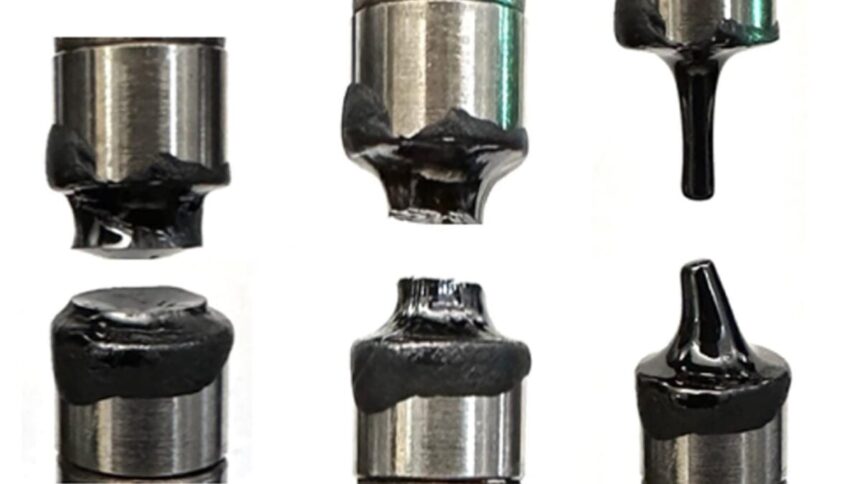
At the most fundamental levels, science often challenges common sense. And a new finding might be the most nonsensical of them all: liquids break.
A recent Physical Review Letters paper, “Unexpected Solidlike Fracture in Simple Liquids,” reports observing exactly that—when liquids are stretched with enough force, the supposedly fluid material fractures like a solid object. The findings suggest that viscosity, or a liquid’s resistance to flowing, may play a greater role in the mechanical properties of liquids than we believed. What’s more, this behavior likely applies to very common liquids, like water or oil, raising new considerations for manipulating liquids across various applications.
“What we observed was so unexpected that we needed to repeat the experiments a few more times to make sure it was real,” Nicolas Alvarez, study co-author and an engineer at Drexel University, said in a statement. “This fundamentally changes our understanding of fluid dynamics.”
Not an equipment issue
The fancy way of describing fractures is to refer to the balance between surface energy and elastic energy release that results in a new interface. More simply, fractures appear when the energy released by a material exceeds the energy required to create a new surface. This is a defining trait that “defines solids” but not liquids, which “yield and flow rather than deform elastically under stress,” according to the paper.
The researchers were initially studying this yielding and flowing behavior in tar-like hydrocarbon blends. What they expected to see was something like the “drawn-out thinning behavior familiar to anyone who’s dolloped a glob of honey into a cup of tea,” according to the statement. Then they heard the noise.
“The fracture caused a very loud snapping noise that actually startled me,” recalled Thamires Lima, the study’s lead author and an engineer at Drexel. “I thought at first the machine had broken but soon realized that the noise came from the stretching fluid.”
Cracking the cracks
According to Lima, the noise resulted in the team pivoting to “an entirely different scientific endeavor.” Once they verified that the noise didn’t come from any equipment failures, the researchers designed experiments to check for similar behavior in liquids with the same viscosity as the hydrocarbons. A high-speed camera recorded each session, giving the team a detailed look into how things unfolded.
Fascinatingly, the liquids showed a consistent pattern of stretching until reaching a “critical stress” point, at which they simply broke in half. This threshold measured up to 2 megapascals, which is equivalent to the “tension you’d unpleasantly experience if you pushed a laundry bag containing 10 bricks off a ledge and its drawstring snagged on your fingernail,” they explained.
This pattern persisted even as temperature shifts adjusted the viscosity, the team reported. The liquid fracture remained proportional to 2 megapascals until each sample’s viscosity dropped low enough such that the equipment, which has a limited stretching capacity, wasn’t able to stretch it any further.
A liquid’s breaking point
The findings challenge the consensus that fracturing is a property of elasticity, or a material’s ability to hold stress. So far, scientists believed that elasticity more or less applied only to solids or to liquids cooled enough such that they started becoming solid-like. But the new study demonstrates that simple liquids with enough viscosity are “enough to promote solid-like fracture behavior,” Lima said.
Next, the researchers plan to identify the precise physical mechanisms behind their unexpected discovery. One hypothesis is cavitation, which refers to the rapid formation and collapse of vapor bubble shockwaves inside liquids.
Most importantly, the team believes that the mechanism is general enough to apply to other simple liquids. If true, that would offer new insights for engineers manipulating liquids “in everything from hydraulics to 3D printers to blood vessels,” the team said.
Read the full article here