
Ramin Djawadi’s Game of Thrones theme is one of the most iconic TV scores of the 2010s. There’s perhaps a reason, then, that when House of the Dragon began, Djawadi returned to Westeros and kind of threw his hands in the air, letting the prequel show simply reuse it for its own opening titles. How does one improve on a TV icon?
Knight of the Seven Kingdoms managed to do so, even if it meant taking a detour with an impromptu poop joke.
When the latest Game of Thrones spinoff kicked off a few weeks ago, there was plenty of chatter about the show’s use of Djawadi’s iconic theme song, its build-up of strings accompanying what seemed like a burgeoning heroic moment for our new protagonist, Ser Duncan the Tall—only for it to be comically cut off as Dunk found his insides betraying him, replacing Game of Thrones as we knew it with a smash-cut to a graphic behind-a-tree bathroom break. It was shorthand to tell us that this wasn’t the Game of Thrones we knew; some took umbrage that it could be seen as disrespecting the franchise and Djawadi’s work, almost quite literally shitting on it.
Since that moment, Knight of the Seven Kingdoms has given us a very different soundtrack in comparison. Composed by Dan Romer, it’s less sweeping strings and orchestral epics and more folksy, whimsical music with a western bent, all plucking guitars and quiet whistles that melt away in the world as actual in-universe songs take over, from bawdy, boozy ballads sung in the Baratheon tents to young Egg’s own playfully innuendo-driven rhyme about the Blackfyre Rebellions. Knight of the Seven Kingdoms is a smaller-scoped show, and so its score matched that vibe.
Until the climax of last week’s brilliant fourth episode, “Seven,” that is. Things have taken a pretty dire turn for the worse for poor Dunk in the last few episodes, after his brave decision to come to the aid of Tanselle the puppeteer—and to briefly beat the snot out of Aerion Targaryen in the process—meant he found himself facing an ancient trial by combat to prove his innocence. Knight of the Seven Kingdoms returns to butt jokes again, as Dunk’s appeal to the gathered crowds to find one more noble warrior to join his side is interrupted by a dude standing up to rip a massive fart in response.
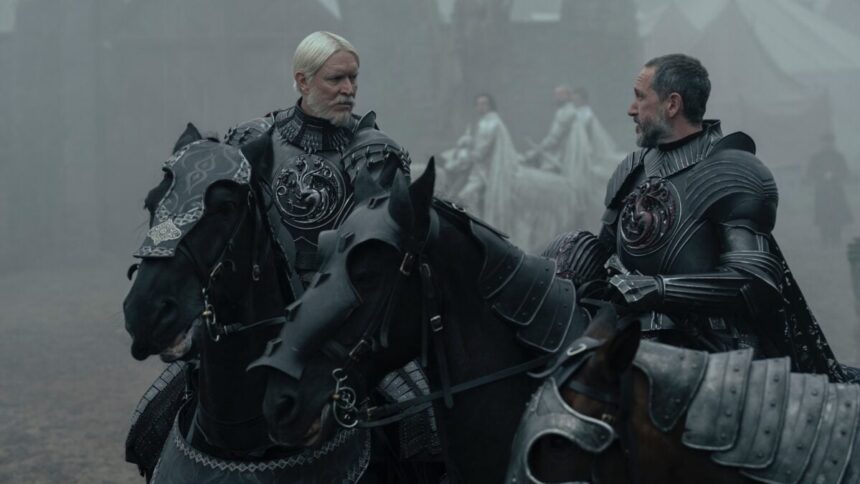
So it’s only fitting that the show uses that opportunity to bring back the Game of Thrones theme too, when Dunk finds the final slot on his group of seven for the trial filled by none other than Baelor Targaryen, Aerion’s uncle and the current heir to the throne. The episode ends on a stunned Dunk and the onlookers at Baelor’s act of nobility, and, of course, with those sweeping strings from Djawadi’s score coming back into the picture—fading into its closing titles with a version of the Game of Thrones theme that blends into an orchestral rendition of Romer’s theme for Dunk, no longer whistled and folksy, but that orchestral epic tone the show had largely avoided up to this point.
And it’s great, because it’s totally earned. If much of Knight of the Seven Kingdoms up to this point has been about the smallfolk (not literal, in Dunk’s case), in this moment it briefly becomes about the heightened fantasy of what knightly, courtly behavior should be to them: a noble prince riding to battle on the side of the downtrodden, even if it means siding against his own family, and a call to arms and better judgment heeded by one of Westeros’ most beloved figures of the time. It makes the use of the Game of Thrones theme for us, the actual audience, become almost diegetic, this theme that we associate with a grander narrative now woven into this smaller, personal one.
It wouldn’t have worked half as well if the show hadn’t already played with our expectations and touched on it jokingly in the first episode. But for a brief moment, Game of Thrones becomes Dunk’s hype theme, or rather, it elevates his own leitmotif to its level. That’s a much more potent use of that particular piece of music than its simple attachment to House of the Dragon out of a sense of expectation.
Want more io9 news? Check out when to expect the latest Marvel, Star Wars, and Star Trek releases, what’s next for the DC Universe on film and TV, and everything you need to know about the future of Doctor Who.
Read the full article here