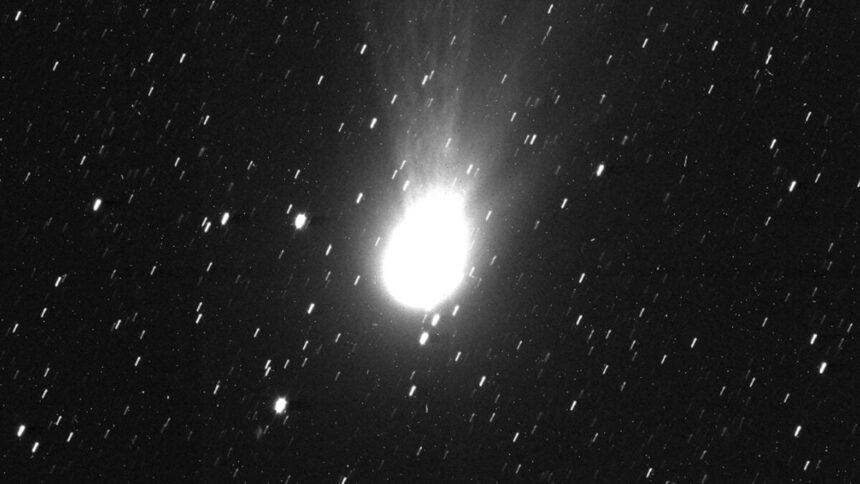
Interstellar visitor comet 3I/Atlas may have bid farewell to Earth, but spacecraft traveling through the solar system kept a close watch on the mysterious traveler. The European Space Agency’s (ESA) Jupiter mission caught a glimpse of the comet shortly after it whizzed past the Sun.
JUpiter ICy moons Explorer, or JUICE for short, captured images of comet 3I/Atlas in spectacular detail, revealing hints of jets, rays, filaments, and streams. The spacecraft directed five of its instruments toward the interstellar object, providing scientists with tantalizing clues on its behavior and composition.
Just passing through
Astronomers first spotted comet 3I/Atlas in data collected by the Asteroid Terrestrial-impact Last Alert System (ATLAS) in June 2025. The International Astronomical Union’s Minor Planet Center confirmed that this comet came from outside our solar system, marking the third discovery of its kind.
Interstellar comets are a rare find, providing scientists with a unique opportunity to study the composition of star systems other than our own. Naturally, the astronomy world was all over it, with scientists trying to gather as much data on the object as they could.
The comet is currently drifting away from the Sun, having passed its closest approach to our star on October 29, 2025. It may have faded from our view on Earth, but deep space missions are still keeping a keen eye on the interstellar visitor.
JUICE is on the job
Using JUICE’s camera, named JANUS, ESA astronomers captured 120 images of comet 3I/Atlas on November 6, 2025, just seven days following the object’s closest approach to the Sun.
In the recently released photos, the comet’s nucleus is surrounded by a bright halo of gas known as the coma, while its long tail is stretched into surrounding space. The arrows highlight the direction in which the comet was moving in relation to the position of the Sun.
JUICE did more than just snap photos of the comet; the spacecraft also collected valuable data on the interstellar object. Teams of scientists at ESA are currently hard at work analyzing the data, and the agency will discuss the findings in late March.
ESA’s JUICE mission launched on April 14, 2023, to probe Jupiter’s icy moons for signs of habitability. The spacecraft is scheduled to reach the Jovian system in 2031. With a long way to go until it reaches its destination, JUICE is making the most of its time in deep space by observing other objects of the cosmos.
Read the full article here