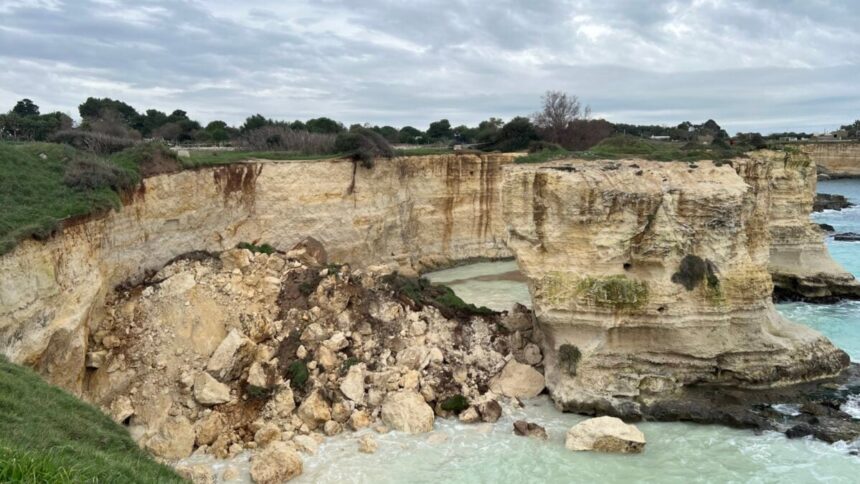
For years, the Faraglioni di Sant’Andrea—an assemblage of limestone off the Adriatic near Italy—has witnessed countless kisses, proposals, and other declarations of love. But a series of bad winter weather reduced the beloved attraction to rubble on February 14. Yup, Valentine’s Day. Thankfully, there are no reports of injuries.
Alas, this was expected, authorities told Corriere Salentino, the local paper. Winter hadn’t been kind to Melendugno, a town near the arch, as powerful Mediterranean cyclones struck coastlines in January. Soon after, another torrential storm ravaged the Iberian Peninsula. The continued stress on the rock formations likely led to the collapse, authorities said.
“It is a devastating blow to the heart,” Melendugno mayor Maurizio Cisternino told local reporters at Corrier Salentino (translated from Italian). “One of the most famous tourist features of our coastline and of the whole of Italy has disappeared.”
“It’s like a funeral,” added Francesco Stella, the region’s tourism councilor.
Mourning a historical landmark
The Faraglioni di Sant’Andrea was dubbed the “Lovers’ Arch” for its popularity among couple visitors. But the rocks, located in Salento, at the “heel” of the boot-shaped Italian peninsula, had long been a “backdrop for a lively web of myths … passed down from generation to generation,” according to Italien News.
Indeed, the arch at its prime—an enormous arch of bright, layered limestone jutting out of turquoise-blue water—inspired countless folktales, Italian News added. For example, local residents believed sirens lived in the hidden grottos, or that the rocks arrived there via mythical giants hurling around the limestone blocks like coins.
These mythical origin stories notwithstanding, there was no doubt that the Lovers’ Arch was a key scientific and environmental trademark for the region. It formed over millennia, as wind and saltwater sculpted the limestone cliffs—a beautiful display of erosion at work.
Nature reclaims its creation?
That said, experts and authorities aren’t sure the recent collapse can be attributed to the same slow, natural forces that shaped the arch in the first place.
“With the Mediterranean [experiencing] among its hottest years on record in 2025, warmer seas are supercharging the atmosphere and fueling extreme events,” Christian Mulder, a climate expert at the University of Catania in Italy, told The Guardian.
In addition to gradually weakening the Lovers’ Arch, these weather events had been the primary driver for serious coastal erosion in the area. Local authorities previously applied for a fund to preserve the coasts but failed to secure funds, Cisternino said.
An ongoing conundrum
In the meantime, the rubble will again weather the wind and rain, eventually returning to the sea. Tourists will probably find another place to visit on Valentine’s Day.
But for locals and experts, the arch’s dramatic collapse resurfaces what risks climate change brings to coastal regions—questions that they’ll have to reckon with for years to come.
Read the full article here