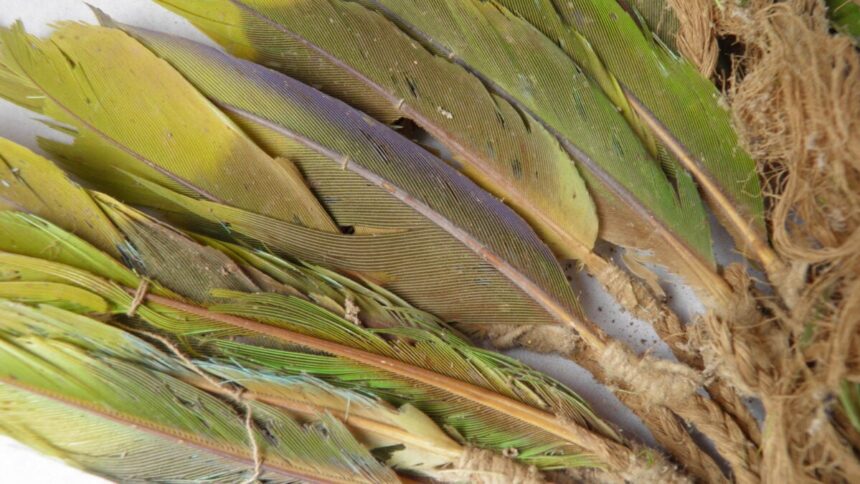
The vibrant feathers of Amazonian parrots were both a fashion statement and a symbol of power for civilizations predating the Inca Empire. And these early fashion leaders went to great lengths for the brightest, prettiest feathers—so much so that they insisted on having live parrots transported over mountains for this cause, as new research suggests.
An international team of researchers discovered a perfectly preserved set of feathers belonging to tropical parrots—inside an exceptionally dry tomb at Pachacamac. The team then sequenced the feather DNA, finding that they likely came from four species of wild-born tropical parrots. What’s more, further chemical research revealed that these parrots lived in captivity near the coast—neither their natural habitat nor where the feathers were recovered. The findings were published today in Nature Communications.
“Our study revealed human ingenuity and drive to resolve physical and logistical challenges of acquiring the desired items over a great distance: the Andes long before the emergence of the powerful Inca Empire,” Izumi Shimada, the study’s senior author and a retired anthropologist with Southern Illinois University, told Gizmodo.
Feathers in a dry land
In the early 2000s, Shimada directed the Pachacamac Archaeological Project, which discovered a very large, intact gravesite belonging to an elite member of the Yschma Kingdom, a pre-Inca society between the years 1100 and 1460. Among the 35 funerary bundles retrieved by the team, five contained colorful bird feather ornaments.
This was an “ecological anomaly” that motivated the newest project, George Olah, the study’s lead author and an interdisciplinary geneticist at the Australian National University, told Gizmodo.
“It has long been known that the colorful feathers of Amazonian parrots were highly valued by ancient cultures across the Americas,” added Shimada. “However, the questions as to the exact identity of the birds, their provenance, how the feathers were acquired, and who was involved in their trade remained to be answered.”
An old parrot’s nomadic lifestyle
First, the team sought to identify which parrots the feathers came from. DNA sequencing of the ancient feathers identified four species: the scarlet macaw, red-and-green macaw, blue-and-yellow macaw, and mealy amazon—all native to the lowland tropical forests on the opposite side of the Andes as the Yschma Kingdom.
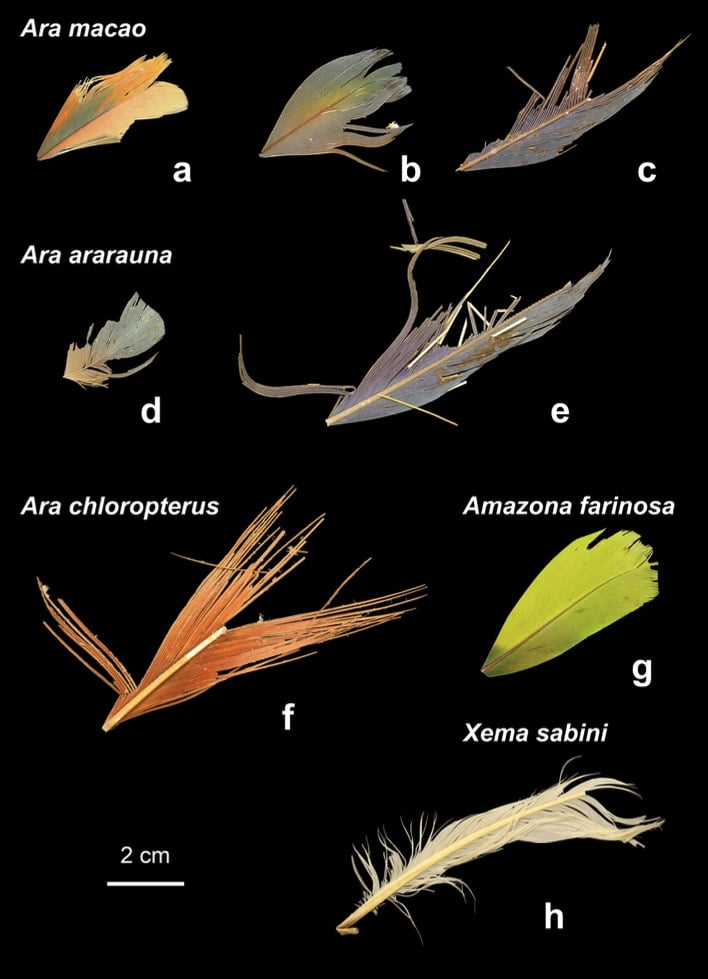
In addition, the high genetic diversity among the samples indicated that these parrots were hatched in the wild. But the weirdness didn’t end there. When the team reconstructed the parrots’ diets using isotope chemistry, they found high carbon content common to things like corn, Shimada said, suggesting the birds had a coastal diet.
Tracking the parrot road
The team suspected that “these birds were wild-caught in the rainforest, transported alive across the Andes, and kept in captivity somewhere on the Pacific coast,” Olah explained. “We moved beyond simply identifying a species in the archaeological record to actually tracking their journey and diet across completely different ecosystems,” he added.

To confirm its hypothesis, the team used a spatial model to map potential routes that living parrots could have taken from the Amazon rainforest to Yschma. This exercise presented two possibilities: one northern route to the northern coast of Peru, past the Chimú Empire, Yschma’s contemporary; or a “physically more challenging route” eastward across the Andes to Pachamac, Shimada said.
“Archaeological evidence favors the former scenario,” he added. “Regardless of which route was taken, our study revealed both a complex economy and long-distance trade in the Yschma culture that long predated the Incan empire.”
An unexplored niche of history
Most importantly, the new findings challenge a certain “Inca-centric view” of South American history, Olah explained. The general academic consensus so far had been that these pre-Inca societies were more isolated, but the study challenges that view, demonstrating that they were actually “managing highly sophisticated, long-distance logistical networks.”
Indeed, wanting vibrant, exotic feathers is one thing; possessing the “ingenuity and drive to resolve physical and logistical challenges” is another, Shimada said. In a broader sense, the findings also shed light on “many well-preserved pre-Hispanic featherworks stored in various museums in Peru and Chile that await our attention,” he added.
“The ancient world was far more interconnected than we often imagine,” Olah concluded. “Understanding how ancient societies utilized, managed, and traded these iconic species gives us a much deeper baseline for how we manage and conserve them today against modern anthropogenic threats.”
Read the full article here