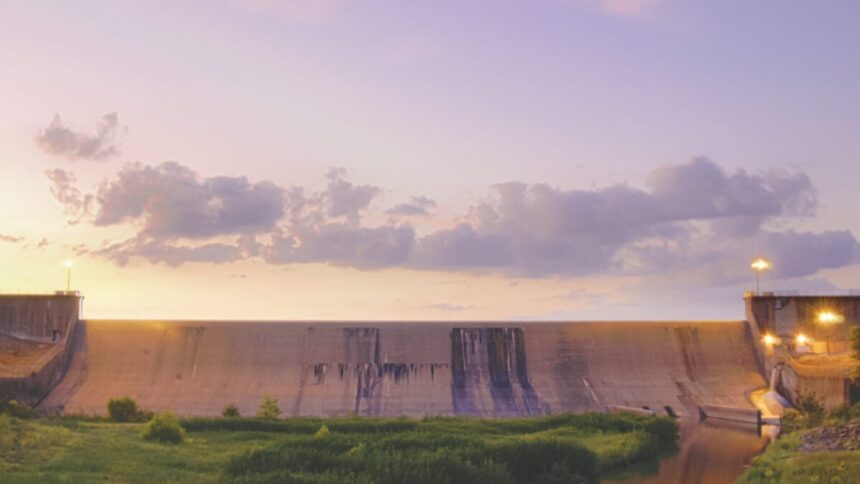
Dams in the United States might have damage that is largely undetectable by safety inspectors.
A team of researchers is using satellite data to investigate large hydroelectric dams in the U.S., and preliminary results reveal that some dams that should have been stabilized were still sinking, possibly affecting their structure.
What’s more, the scientists found that a significant number of the country’s most damaged dams threaten many socially vulnerable communities that might not have strong emergency preparedness. Virginia Tech geoscientist Mohammad Khorrami will present the research during the American Geophysical Union’s (AGU) 2025 Annual Meeting on Thursday.
Internal degradation
As of 2024, over 16,500 dams in the U.S. are classified as high hazard potential, according to the Association of State Dam Safety Officials. More than 2,500 of them are in poor condition, and the country’s 92,075 are on average 61 years old, per FEMA’s National Inventory of Dams.
Within this context, it’s difficult to discern the solidity of structures beneath a dam. As such, Khorrami and his colleagues came up with a new, remote approach to keep an eye on the structural soundness of large dams—satellite data. The team used radar technology from the Sentinel-1 satellite to investigate how parts of high-risk dams have sunk over a decade-long period, focusing on hydroelectric dams 50 feet (about 15 meters) or taller.
If they fail, these structures pose the greatest potential risk to both people immediately downstream and the infrastructure they can power.
“I want to emphasize that this is a preliminary result,” said Manoochehr Shirzaei, a Virginia Tech geoscientist and co-author of the research. “We need to do further analysis to have a concrete answer. But some of the observations may suggest that some of these infrastructures are undergoing internal degradation.”
A risk to people and the economy
In one case, the team’s work validated previous inspections indicating that a dam in North Carolina was sinking on its northern face, damaging the structure and posing a risk to a town below it.
The researchers integrated the dams’ structural information with the satellite data to reveal particular threats posed by individual dams. By layering on data from the census, FEMA’s National Risk Index, and FEMA’s flood inundation zones, they found that a large quantity of the worst-off dams could wreck many vulnerable communities in the U.S.—groups of people that might not have strong emergency preparedness, such as access to resources in the case of a flood.
The disastrous consequences of one of these large hydropower dams failing, however, would extend beyond the flooded communities. “Some of the dams actually serve as a sub-buffer for water that’s used for agriculture and for electricity production. Those dams can create a ripple effect if they fail that can impact the national economy,” Shirzaei explained.
Prioritizing dams for funding
Climate change is also an additional stressor for aging U.S. dams. Strong rainstorms have started to seriously strain these structures, adding more water in significantly shorter amounts of time.
Overall, dams in the U.S. might be worse off than we knew, and the team’s work can help policymakers prioritize their limited funding on dams that need it the most.
However, Khorrami points out that communities still have a lot of power in the context of dam safety. Previous research has shown that an important amount of dam failure results from poor management or absence of maintenance, which means that “almost 40-50% [of dam risk] is something that is in our hands,” Khorrami said.
“The next step is to create these dynamic risk models that can be updated on a regular basis using the data that we produce,” Shirzaei concluded. They aim to develop a publicly available interactive map with contemporary and future information about precarious U.S. dams.
Read the full article here