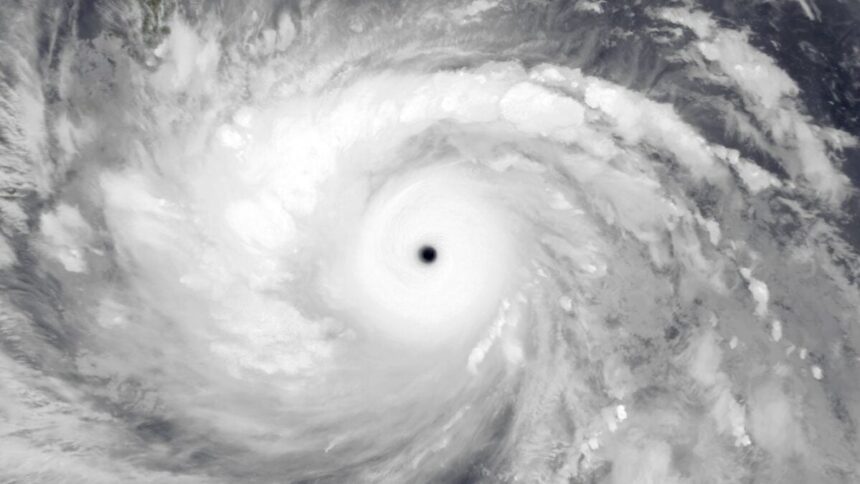
Milton. Haiyan. Patricia. These names conjure memories of supercharged tropical cyclones that churned up a debate over whether we need a “Category 6” for hurricanes. One team of experts believes we do, especially because their latest research suggests these storms pose a growing threat to densely populated areas.
I-I Lin, a chair professor in the Department of Atmospheric Science at the National Taiwan University, presented her team’s research at the annual meeting of the American Geophysical Union (AGU) in New Orleans on Wednesday. The findings, which have yet to undergo peer review, show that regional “hotspots” of above-average ocean temperatures in the North Atlantic and western Pacific—the incubators of mega-hurricanes—are rapidly expanding.
Lin and her colleagues believe this strengthens the case for a Category 6, which could help cities better prepare for the impact of extremely high-intensity hurricanes—especially in areas where they are becoming more common.
“We really think there is a need just to provide the public with more important information,” Lin said in an AGU release.
The case for a Category 6
Typhoon Haiyan slammed into the Philippines in 2013, killing at least 6,300 people and displacing millions more. A year later, Lin led a study that attributed Haiyan’s unprecedented intensification in large part to warm subsurface water temperatures in the western tropical Pacific.
The storm reached a maximum sustained wind speed of 195 miles per hour (315 kilometers per hour), which is well above the Category 5 threshold of 157 mph (252 kph). In fact, Haiyan remains one of the most powerful tropical cyclones to ever hit land.
In their paper, Lin and her colleagues built a case for adding a Category 6 to the Saffir-Simpson Hurricane Wind Scale (SSHWS) to accommodate storms with a maximum wind intensity above 184 mph (296 kph), like Haiyan. The scale currently designates any storm with a maximum sustained wind speed of over 157 mph (252 kph) a Category 5, no matter how much more intense it is.
The expanding threat of mega-hurricanes
Lin’s new research analyzed all large storms recorded over the past 40 years, finding that Category 6 cyclones have become increasingly common. There were eight such storms between 1982 and 2011, but 10 between 2013 and 2023. That means a quarter of the Category 6 storms that occurred over the past four decades happened in the last 10 years.
The study revealed that most of these cyclones occur in warm-water hotspots, the largest of which lies in the western Pacific, east of the Philippines and Borneo. Another is located in the North Atlantic, east of Cuba, Hispaniola, and Florida.
The findings also show that these hotspots are growing larger. The one in the North Atlantic, for example, has expanded eastward past the northern coast of South America and westward into the Gulf of Mexico. Lin and her colleagues estimate that human-driven global warming is responsible for 60% to 70% of hotspot growth and, consequently, the likelihood of Category 6 hurricane formation.
As the world rapidly warms, it’s clear that we’re facing an entirely new level of tropical storm danger. The debate over whether we should add a Category 6 to the SSHWS—or perhaps even build a whole new scale—remains unsettled, but this new data underscores the urgency of communicating the rising threat of ultra-intense storms.
Read the full article here