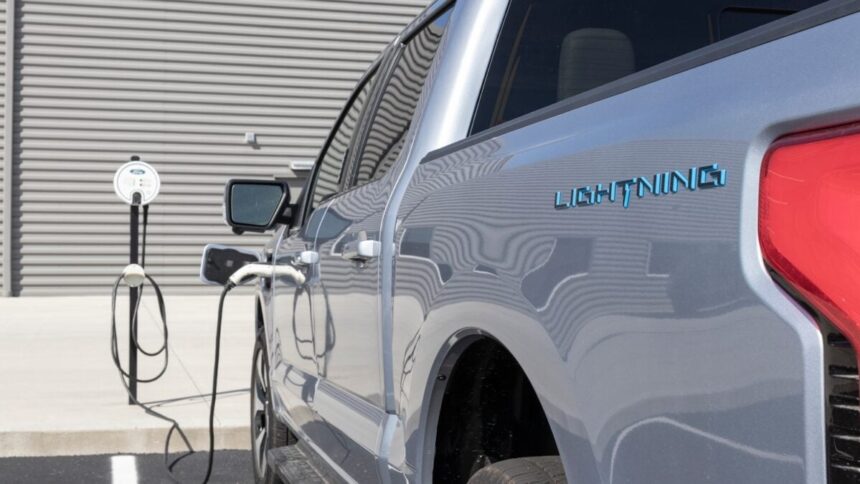
The end of the best-selling electric pickup truck is here: Ford is pulling the plug on the F-150 Lightning by the end of the year. It’s not dead dead, but the next version of the Lightning will be an extended range electric vehicle, known as an EREV. Ford is positioning it as the “next-generation.”
In a news release Monday, Ford announced the end of current Lightning production and called the EREV “a significant expansion of the F-150 Lightning’s capability.” With the EREV set-up, Ford will add a gas engine that acts as a generator for the EV components. This will give the Lightning EREV over 700 miles of range.
The original Lightning was the darling of the Biden administration, showing how America’s top-selling truck was embracing the inevitable electric future. The former president even drove one on the White House South Lawn. Then Donald Trump was voted back into office and his administration immediately pushed back on EV-friendly policies, namely the $7,500 tax incentive for new (and eligible) EV purchases.
So while not inherently a political decision, Ford most likely called it on the Lightning because of Trump administration policy decisions. Before the consumer tax credit expired on Sep. 30, Lightning sales popped: in September alone nearly 4,000 electric trucks were sold, a 135% increase from the year prior. October and November saw a sudden downturn, plummeting to about 1,000 trucks sold in November.
Launched in 2021, the Lightning was in a constant battle with cost. The market wanted and expected a more affordable pickup truck that never materialized even with federal discounts. The most affordable Lightning trim for non-fleet owners starts at $63,345—for the next two weeks at least.
The company admitted to cost problems in a separate news release Monday about “shifting to higher-return opportunities.” Without naming the Lightning (Ford only has the Mustang Mach-E and Lightning for everyday carbuyers), the company announced that it will no longer “produce select larger electric vehicles where the business case has eroded due to lower-than-expected demand, high costs and regulatory changes.” It said it would take $19.5 billion in charges to revitalize its electric strategy by 2029.
Automotive research firm AutoPacific president and chief analyst Ed Kim doesn’t think this is as dire as it sounds. “I don’t think this spells the end for electric trucks,” he said. “It’s just going to take longer to get there than expected.”
The F-150 as an all-electric vehicle was always a big ask for truck customers, especially with concerns about range, long drives and towing and charging infrastructure. Ford looked to what Ram decided to do with its electric truck plans: drop the full EV Ram 1500 and opt for at least some electrification with an EREV. “The market isn’t quite ready to go all electric yet,” Kim said.
For electric pickups like the Rivian R1T and Tesla Cybertruck that come from electric-first companies, Kim buckets them into a separate category altogether. He sees Cybertruck owners purchasing the truck for the lifestyle, not as a work truck or for the professional legacy.
“In the end, the next-generation Lightning is still an electric truck,” Kim said in a phone call. “It’s like an EV with training wheels.”
But still, RIP to the F-150 Lightning. Here’s hoping the next iteration keeps the massive “Mega Power Frunk.”
Read the full article here