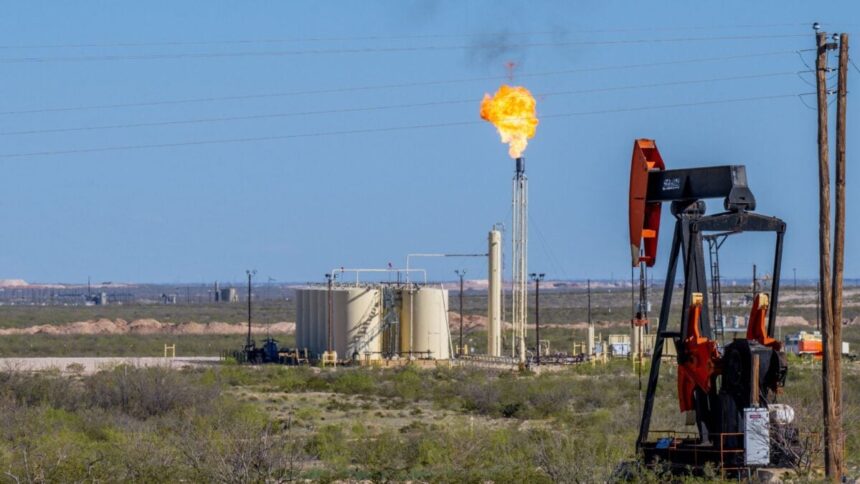
Fossil fuel extraction is a known source of methane leaks, releasing large amounts of this potent greenhouse gas into the atmosphere. Yet the Environmental Protection Agency appears to be drastically underreporting emissions from the nation’s largest oil-producing region.
Nearly half of U.S. oil comes from the Permian Basin in West Texas and southeastern New Mexico. The region generates more than $100 billion annually for the U.S. economy, and apparently, a whole lot of methane, too. A recent report from MethaneSAT—a methane-sensing satellite that observed Earth from March 2024 to June 2025—found emissions from the Permian Basin to be nearly four times higher than the EPA’s official estimates.
On Wednesday, Senator Sheldon Whitehouse (D-RI), the ranking member of the Senate Environment and Public Works Committee, announced he would be launching an investigation into this stark discrepancy.
“The inconsistency between emissions reported to EPA’s Greenhouse [Gas] Inventory and satellite data suggest that significant, previously unreported emissions may be occurring,” the senator said in a statement. As a result, “substantial opportunities exist to reduce waste, improve operational efficiency, and mitigate climate change.”
The EPA did not provide answers to Gizmodo’s questions by the time of publication.
Downplaying the damage
MethaneSAT, launched by the Environmental Defense Fund, was equipped with state-of-the-art spectrometers that could detect subtle traces of methane emissions across entire oil and gas fields. This allowed the satellite to zero-in on hot spots with unmatched precision, producing high-resolution snapshots of methane leaks.
Unfortunately, MethaneSAT was only in orbit for 15 months before it unexpectedly went dark. Even during that short observation period, the satellite managed to gather invaluable data on the fossil fuel industry’s methane emissions. An analysis of the data, published in February, showed that emissions consistently and significantly exceed figures reported in widely cited inventories.
The greatest discrepancy was in the Permian Basin, where observed methane emissions were 410 metric tons per hour. Meanwhile, the EPA’s Greenhouse Gas Inventory reports that the basin’s methane emissions are 104 metric tons per hour.
Both of those emissions rates are incredibly high. The EPA defines a “super-emitter” as any oil and natural gas facility emitting at least 220 pounds of methane per hour (100 kilograms per hour).
Even if the agency’s estimate for the Permian Basin is accurate—which is arguably unlikely given the sophistication of MethaneSAT’s sensors and the recency of its data—it’s clear the basin is contributing significantly to global warming. Methane is a particularly powerful greenhouse gas, trapping 28 times more heat in the atmosphere than carbon dioxide.
A demand for transparency
In light of the MethaneSAT report, Senator Whitehouse has asked eight leading energy companies operating in the Permian Basin to disclose their current methane emissions estimates and how they are measured by April 1. He has also demanded that they provide information about the steps they are taking to reduce their emissions.
Those companies are EOG Resources, ConocoPhillips, Occidental Petroleum, ExxonMobil, Diamondback Energy, Devon Energy, Chevron, and Mewbourne Oil Co.
In his statement, Whitehouse argued that methane abatement in the oil and gas sector can largely be done at no net cost, as captured methane emissions can be turned into a commodity.
“This is particularly true at a moment in time when natural gas and [liquefied natural gas] prices are spiking due to the ongoing war in Iran,” he said. “Capturing all of this wasted methane would help increase global supplies of natural gas and reduce prices for consumers and industry.”
The outcome of Whitehouse’s efforts remains to be seen. Under an administration that is determined to protect the fossil fuel industry at all cost, it seems unlikely that the EPA will push companies to reduce their emissions.
Read the full article here