For scientists, the urgent problem with phosphine—a molecule famously touted as a potential sign of life—isn’t so much about where it came from, but why it’s not where we think it should be. After a decade of searching, a long-awaited result has confirmed that our astronomical models aren’t a total bust. At least, for now.
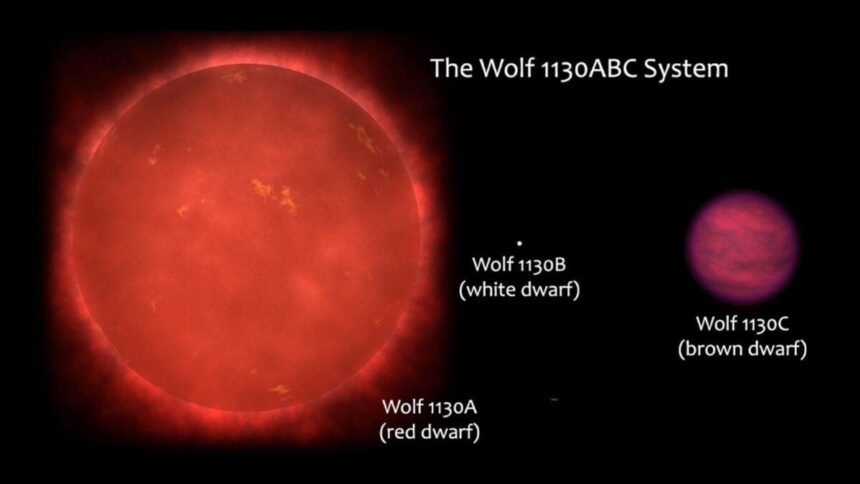
In a Science paper published today, astronomers report the first-ever detection of strong phosphine signatures on a brown dwarf—a type of planet-star hybrid more massive than planets like Jupiter but not quite big enough to sustain the hydrogen fusion that powers stars. Prominent chemical models had long predicted that cosmic entities with gassy atmospheres would be rich in phosphine, but years of searching had turned up nearly nothing. The findings thus give closure to a problem that had plagued astronomers for at least a decade.
Just as importantly, the finding carries important implications for astrobiology. The phosphine detected on this brown dwarf, named Wolf 1130C, almost certainly formed through natural, abiotic processes. The challenge now is figuring out how an object like this could generate so much of it without life. Until researchers can explain that, any detection of phosphine—whether on a gas giant or a rocky planet like Venus—can’t be taken as a reliable sign of biology.
“The community has been waiting for this,” said Sara Seager, an MIT astrophysicist not involved in the new work. Seager co-authored a seminal paper from 2020 on the detection of phosphine on Venus. On Earth, phosphine mainly exists as the byproduct of anaerobic life, or creatures that thrive without oxygen. Because Venus’s chemical environment isn’t conducive to the natural formation of phosphine, the 2020 paper left astronomers wondering if the phosphine could have come from a life source—a biosignature.
“It is very refreshing—finally!” Nathalie Cabrol, research director at the SETI Institute’s Carl Sagan Center, added. Cabrol, also uninvolved in the new study, told Gizmodo in a video call that the paper presents “clear, plain” data of phosphine on the brown dwarf—just as models predicted.
A wild phosphine chase
Had the results come ten years ago, it wouldn’t have been this big of a deal, Adam Burgasser, study lead author and an astrophysicist at the University of California, San Diego, told Gizmodo. Chemical models had long supported the natural presence of phosphine on brown dwarfs or exoplanets with gassy atmospheres. That Jupiter and Saturn have phosphine-rich atmospheres also contributed to this assumption.
But after a decade of finding zero (or rather, several contested) signs of phosphine where models expected it to be, astronomers started to get rather skittish, explained Burgasser. In fact, astronomers had started to seriously consider substantially revising major models to account for the lack of phosphine.
“It’s been a real weird problem, because it’s just this one molecule that seems to be a little bit out of sync,” Burgasser said. “So, it’s actually a surprise that we have now finally detected it—in fact, detected it in abundance in this one particular brown dwarf.”
A Webb search
Wolf 1130C is located around 54.1 light-years from Earth. The team chose this object for its slightly unusual composition, low metallicity, and comparatively low surface temperature. The idea was to take a slightly different approach, since previous surveys had already targeted brown dwarfs with the right temperature or composition, yet astronomers hadn’t “seen the level of phosphine that we would expect,” Burgasser explained.
Their hunch turned out to be correct. While studying spectral data from the James Webb Telescope’s Near-Infrared Spectrograph, the team noticed a distinct check mark in their plot—a shape characteristic of phosphine signatures. But the researchers swallowed their excitement to double- and triple-check their work.
“We were like, ‘We have to make sure this is absolutely correct,’” Burgasser recalled. Fortunately, the team included a computational modeling expert who ran week-long simulations of the dwarf’s atmosphere, along with a scientist whose career had revolved around phosphine.
“A combination of all these things—plus the analysis we did to [describe] the abundances—made us realize that we had a very obvious and solid detection,” Burgasser said.
No aliens here
Again, the detection doesn’t represent a biosignature, which Burgasser, Seager, and Cabrol all emphasized. That has to do with an often glossed-over aspect of finding signs of alien life, Cabrol said. No molecule by itself is necessarily a biosignature; rather, we’re looking for the “co-evolution of life and its environment,” she said. In other words, a compound qualifies as a biosignature only if the surrounding environment suggests it couldn’t have formed through non-biological chemistry alone.
Checking such environmental contexts would be easier for places like Venus, which is close enough for us to plan missions, Cabrol explained. “We don’t have this luxury with exoplanets. When you don’t know the environment…you cannot claim that something is a biosignature unless something is being replenished in a way that nature alone cannot explain.”
For brown dwarfs, phosphine is not a biosignature. These stellar bodies are hot and hydrogen-rich, which is conducive to the presence of phosphine, Seager said.
“Chemically, there’s no life involved in that,” Burgasser added.
Homework from the universe
That said, the team isn’t completely certain how so much phosphine ended up on Wolf 1130C, although they do explore some options. It could be due to the brown dwarf’s low metallicity, or the local environment could have been conducive to the accumulation of phosphine on Wolf 1130C. Overall, the researchers aren’t sure.
At the same time, “the inability of models to consistently explain all these sources indicates an incomplete understanding of phosphorus chemistry in low-temperature atmospheres,” the paper noted.
It’s as if nature came in and said, “Yeah, here’s more homework, a harder test question for you,” Burgasser joked. “We don’t even understand the natural chemistry for phosphorus—until we get that right, we can’t really rely on phosphine as a viable biosignature,” he added.
The obvious next step would be to look for other objects with similar supplies of phosphine, which could help fill in the gaps that remain. Of course, it’s entirely possible that future discoveries may throw models into even further confusion. Either way, the findings mark a new chapter in our understanding of the cosmos.
“But the process that will be leading to that day is beautiful in itself,” Cabrol said, “because it’s the progress of human knowledge.”
Read the full article here