

By using this site, you agree to the Privacy Policy and Terms of Use.
Accept
Tech Consumer JournalTech Consumer JournalTech Consumer Journal
  • News
  • Phones
  • Tablets
  • Wearable
  • Home Tech
  • Streaming
Reading: Extreme Closeup of the ‘Eye of God’ Reveals Fiery Pillars in Stunning Detail
Share
Sign In
Notification Show More
Font ResizerAa
Tech Consumer JournalTech Consumer Journal
Font ResizerAa
  • News
  • Phones
  • Tablets
  • Wearable
  • Home Tech
  • Streaming
Search
  • News
  • Phones
  • Tablets
  • Wearable
  • Home Tech
  • Streaming
Have an existing account? Sign In
Follow US
  • Contact
  • Blog
  • Complaint
  • Advertise
© 2022 Foxiz News Network. Ruby Design Company. All Rights Reserved.
Tech Consumer Journal > News > Extreme Closeup of the ‘Eye of God’ Reveals Fiery Pillars in Stunning Detail
News

Extreme Closeup of the ‘Eye of God’ Reveals Fiery Pillars in Stunning Detail

News Room
Last updated: January 21, 2026 4:02 am
News Room
Share
SHARE

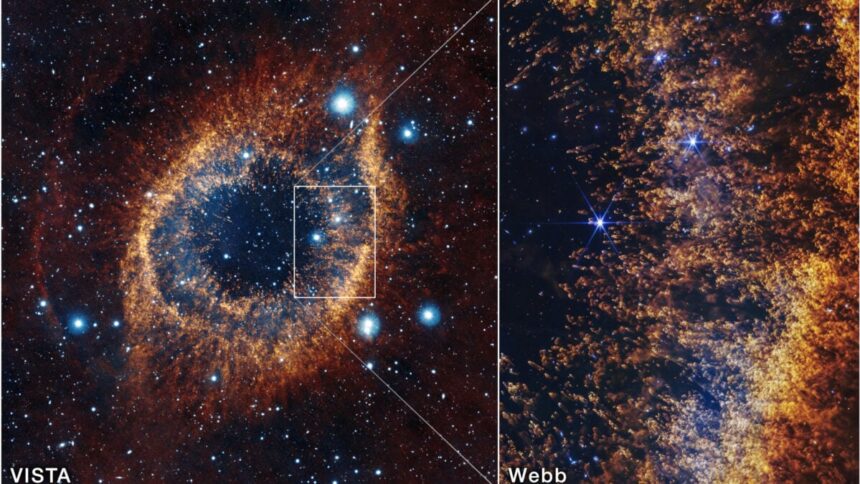
The Webb space telescope has stared deep into the darkness of the Helix Nebula, revealing layers of gas shed by a dying star to seed the cosmos with future generations of stars and planets.

A new Webb image captures a zoomed-in view of the iconic nebula, also known as the Eye of Sauron or Eye of God for its piercing, eye-shaped appearance. At its center is a blazing white dwarf—the leftover core of a dying star—releasing an avalanche of material that crashes into a colder surrounding shell of gas and dust.

A new image from NASA’s James Webb Space Telescope of a portion of the Helix Nebula highlights comet-like knots, fierce stellar winds, and layers of gas shed off by a dying star interacting with its surrounding environment. Webb’s image also shows the stark transition between the hottest gas and the coolest gas as the shell expands out from the central white dwarf. Image: NASA, ESA, CSA, STScI; Image Processing: Alyssa Pagan (STScI)

The image provides a glimpse into the future of stars like the Sun once they’ve reached the end of their life cycle, recycling material of their own to birth new planetary systems.

Clear vision

Using Webb’s NIRCam (Near-Infrared Camera), the small portion of the Helix Nebula comes into full view to reveal comet-like knots, blazing stellar winds, and layers of gas.

The high-resolution image shows cloudy pillars that resemble flames surrounding the inner region of an expanding shell of gas. Winds of fast-moving, hot gas from the dying star crash into slower, colder shells of gas and dust shed by the star at an earlier point in its life, creating the nebula’s unique shape.

The white dwarf, out of the frame of Webb’s zoomed-in image, lies at the heart of the nebula. Radiation from the dying star lights up the surrounding gas, creating layers of material like a cosmic lasagna. Closest to the white dwarf is hot ionized gas, with cooler molecular hydrogen farther out and protective pockets within dust clouds where more complex molecules can start to form. This is the raw material that could eventually mold itself into planets and star systems.

In the Webb image, the temperature and chemistry of the material are represented by different colors. The blue hue marks the hottest gas in this field, energized by intense ultraviolet light from the white dwarf. Farther out, the gas cools into the yellow regions where hydrogen atoms join into molecules. At the nebula’s outer edges, reddish tones mark the coolest material, where thinning gas gives way to dust formation, according to NASA.

A dying star

The nebula was first spotted in the 1800s and has since become one of the most iconic features of our night skies for its striking shape and proximity. Located just 650 light-years away from Earth in the constellation Aquarius, the eye-shaped nebula is one of the closest of all bright planetary nebulae to our planet’s view.

Astronomers have used ground-based and space observatories to stare into the Eye of Sauron, observing the final moments of a dying star in great detail.

Read the full article here

You Might Also Like

How Open Is Too Open?

‘Pirates of the Caribbean’ Director Has a Theory on Why Visual FX Suck So Much Now

American Pediatricians Say You’re Thinking Way Too Much About Screen Time Limits

It’s Time for Nvidia to Prove It Can Do More Than Graphics Cards for PCs

Volvo’s EX60 Promises 400-mile Range in a More Competitive EV Climate

Share This Article
Facebook Twitter Copy Link Print
Previous Article Elon Musk Makes Part of X Algorithm Open Source, Says It ‘Sucks’
Next Article A Brief Reminder of When ‘A Knight of the Seven Kingdoms’ Takes Place
Leave a comment

Leave a Reply Cancel reply

Your email address will not be published. Required fields are marked *

Stay Connected

248.1kLike
69.1kFollow
134kPin
54.3kFollow

Latest News

Nvidia CEO Says the AI Boom Will Lead to More Jobs for Plumbers
News
The First Look at ‘For All Mankind’ Season 5 Soars
News
Mike Colter Says Luke Cage Might Be Preparing for a MCU Return
News
Does It Matter If Dunk Was Really Knighted on ‘A Knight of the Seven Kingdoms’?
News
Holy Crap, So Many People Watched ‘KPop Demon Hunters’ Last Year
News
Document Disclosures Reveal Microsoft’s Influence as OpenAI Became a Revenue-Crazed Behemoth
News
Trump Family Makes $1.4 Billion Off Crypto in 2025, Offsetting Losses Elsewhere
News
Riz Ahmed Made a TV Show About the Hunt for James Bond
News

You Might also Like

News

The Posting Presidency Has Never Felt More Impotent

News Room News Room 11 Min Read
News

‘Lore Olympus’ Will Be Prime Video’s Next Animated Show

News Room News Room 2 Min Read
News

Map Reveals Bizarre January Drought Hitting 130 Million Americans

News Room News Room 6 Min Read
Tech Consumer JournalTech Consumer Journal
Follow US
2024 © Prices.com LLC. All Rights Reserved.
  • Privacy Policy
  • Terms of use
  • For Advertisers
  • Contact
Welcome Back!

Sign in to your account

Username or Email Address
Password

Lost your password?