
By using this site, you agree to the Privacy Policy and Terms of Use.
Accept
Tech Consumer JournalTech Consumer JournalTech Consumer Journal
  • News
  • Phones
  • Tablets
  • Wearable
  • Home Tech
  • Streaming
  • More Articles
Reading: Even Black Holes Can Get Indigestion. Unsurprisingly, Their Farts Are ‘Massive’ Expulsions of Gas
Share
Sign In
Notification Show More
Font ResizerAa
Tech Consumer JournalTech Consumer Journal
Font ResizerAa
  • News
  • Phones
  • Tablets
  • Wearable
  • Home Tech
  • Streaming
  • More Articles
Search
  • News
  • Phones
  • Tablets
  • Wearable
  • Home Tech
  • Streaming
  • More Articles
Have an existing account? Sign In
Follow US
  • Contact
  • Blog
  • Complaint
  • Advertise
© 2022 Foxiz News Network. Ruby Design Company. All Rights Reserved.
Tech Consumer Journal > News > Even Black Holes Can Get Indigestion. Unsurprisingly, Their Farts Are ‘Massive’ Expulsions of Gas
News

Even Black Holes Can Get Indigestion. Unsurprisingly, Their Farts Are ‘Massive’ Expulsions of Gas

News Room
Last updated: August 4, 2026 2:30 am
News Room
Share
SHARE

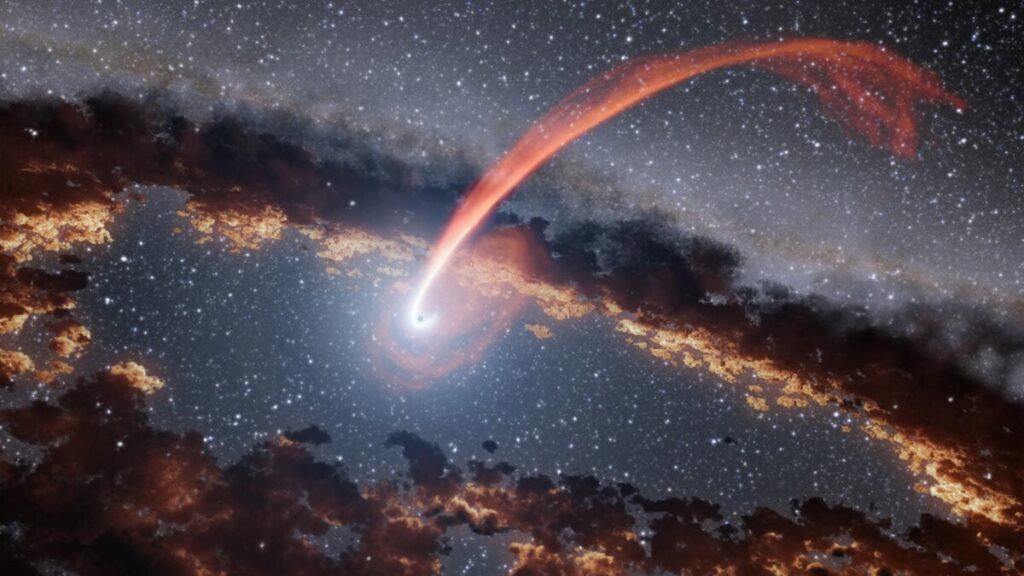
Black holes are typically seen as enormous, bottomless pits with an insatiable appetite for cosmic matter—if anything, that’s probably the one thing people know about them. But it seems the universe had other ideas.

Even black holes get indigestion from swallowing too much stuff, according to a recent paper published in Monthly Notices of the Royal Astronomical Society. Researchers came to this conclusion after studying high-resolution optical records of a black hole eruption from 2023. The unprecedented event allowed astronomers to pick apart a specific black hole’s behavior over time. Through their research, the team saw that the black hole didn’t endlessly consume matter, but rather eventually redistributed a substantial portion of its meal back into space.

“People often imagine black holes simply swallowing everything around them,” Noel Castro Segura, the study’s lead author and a postdoctoral researcher at the University of Warwick in the U.K., said in a statement. “What we’re seeing is a much more complex process. Matter falls in, the system processes it, and a surprising amount is expelled again.”

A flash in the cosmos

Swift J1727.8−1613 consists of a black hole surrounded by a swirl of superheated stellar material pulled from a nearby star. Astronomers first got wind of the black hole system in 2023, when it erupted in an extremely luminous X-ray burst that reached Earthbound laboratories. Since then, researchers have used the Very Large Telescope in Chile to “watch this feeding process unfold in real time as vents have rarely been observed in such quality,” according to media release by the University of Warwick.

This by itself was a rare opportunity, but things took a strange turn once the black hole apparently finished “eating” the star, so to speak. Specifically, researchers noticed an intense storm of gas blowing outward from the system. That is, long after its meal, the black hole was gradually spitting matter back out, not keeping it down. This suggests that a “significant fraction of the meal may never reach the black hole at all,” Castro Segura explained.

Galactic indigestion?

It would make sense for there to be some bidirectional exchange of matter, given the extreme chaos surrounding black holes. However, the team explained in the paper that the volume of regurgitated stuff was continuously expelled for at least 10% of the transferred mass. Assuming this outflow continuously redistributes matter back into space, it could mean that the “material being expelled could rival the amount ultimately consumed by the black hole itself,” according to the statement.

“We usually gravitate towards the dramatic fireworks when a black hole outburst begins, but our observations show that the finale can be just as intense,” Kyle Solomons, the study’s co-author and a doctoral researcher at the University of Cape Town in South Africa, said in the statement. “Even as the system’s X-ray emission dropped to a fraction of its peak, it still had enough power to generate a massive expulsion of gas.”

Fundamentally speaking, black holes don’t emit or reflect light. As a result, astronomers typically depend on things around them to clue them into the activity of black holes. But as technology evolves, scientists have been getting better at probing the “invisible” part of a black hole’s behavior—findings that continue to challenge our assumptions about one of the most extreme, enigmatic phenomena in the universe.

Read the full article here

You Might Also Like

Liquid Fluoride Can Stop Cavities Without Drilling, Major Trial Finds

SpaceX Is About to Find Out How Many Insiders Want to Hit the Eject Button

No One Knows What the Hell Elon Musk’s AI Graph Means

The Tariff Refunds Are Rolling in—but Gadget Prices Aren’t Dropping

The CEO of Bluesky Says He Wants Less of a Focus on Liberal Politics (and More Sports)

Share This Article
Facebook Twitter Copy Link Print
Previous Article Trump Admin Has the Concept of a Plan for AI Safety Rules (Maybe)
Next Article The CEO of Bluesky Says He Wants Less of a Focus on Liberal Politics (and More Sports)
Leave a comment

Leave a Reply Cancel reply

Your email address will not be published. Required fields are marked *

Stay Connected

248.1kLike
69.1kFollow
134kPin
54.3kFollow

Latest News

Trump Admin Has the Concept of a Plan for AI Safety Rules (Maybe)
News
A16Z Brags That Its AI Is Great for Poisoning the Internet With Fake Tech History
News
Dave Bautista May Take Over Kratos Role in ‘God of War’ TV Series
News
Kevin Feige on the ‘Brand New Day’ Box Office and What’s Next for Spidey and Marvel
News
Chilean Mummies Prove Europeans Brought Smallpox to the Americas—But That’s Not All
News
‘Warhammer 40,000’ Animated Series Based on ‘Secret Level’ Episode in the Works
News
The First Full ‘Star Wars’ Anime Series Arrives This Week
News
‘House of the Dragon’ Star Gayle Rankin on What It’s Like Being a Freaky Westeros Witch
News

You Might also Like

News

‘V/H/S/Mixtape’ Will Blend Found Footage Horror With Music

News Room News Room 2 Min Read
News

Early Social Media Use Linked to Lower Grades Years Later, Study Finds

News Room News Room 6 Min Read
News

Today in Can It Run Doom?: Microsoft Paint!

News Room News Room 7 Min Read
Tech Consumer JournalTech Consumer Journal
Follow US
2024 © Prices.com LLC. All Rights Reserved.
  • Privacy Policy
  • Terms of use
  • For Advertisers
  • Contact
Welcome Back!

Sign in to your account

Username or Email Address
Password

Lost your password?