For film fans, a movie being inducted into the Criterion Collection is a mark of some level of quality and notability. Similarly prestigious (if not so exclusive) is the Criterion Channel streaming service, which features a curated, rotating collection of important, influential, or acclaimed films and TV shows. It’s the digital equivalent of when a local video store would have a shelf of Staff Picks—if that weren’t an extremely outdated concept these days.
So it’s an impressive achievement that Hideaki Anno’s Neon Genesis Evangelion is now available on the Criterion Channel in both Japanese and the original English dub—the one you heard when Evangelion aired on Adult Swim 20 years ago and maybe haven’t heard since. That means it’s being presented on the same level as other acclaimed Criterion Channel offerings like Blue Velvet, The Night of the Hunter, and The Umbrellas of Cherbourg. The thing about Criterion, both the Collection and the Channel, is that its handy presentation of prestigious works can seem like a shortcut to an education on appreciating good art, and while Evangelion is certainly good art, it becomes even better when you move past what Criterion is offering and explore the context that the series comes from.
Though Evangelion proudly contains a lot of narrative and thematic juice that its fans and creators have spent decades contemplating (Anno’s End of Evangelion movie and Rebuild of Evangelion remake series are as much about Eva itself as they are about anything else), the series is, at its heart, part of the mecha anime genre. And the most important and iconic work in the mecha anime genre—not counting Eva, if anyone wanted to make that argument—is Mobile Suit Gundam. Released in 1979, Gundam was a rejection of the “super robot” approach to mecha anime that was popularized in Japan in the ‘50s and ‘60s and effectively created a new sub-genre dubbed “real robot.”
In a “super robot” story, the big robot is basically a superhero created by ancient aliens or whatever that fights monsters or other big robots, with a “pilot” (usually a kid, which is important) controlling the robot with their voice or mental commands. In a “real robot” story, the robot is actually built by someone and is controlled like a vehicle—with switches and levers and pedals. One also tends to be a little more cartoony and fantastical, while the other tends to be closer to hard sci-fi.
Despite their differences, one important aspect of “super robot” stories that Gundam retained for its more serious take on things (while semi-contemporaries like Super Dimension Fortress Macross did not) was the trope of the young teen protagonist who controls the robot. The first episode of Gundam introduces Amuro Ray, a latchkey kid whose father, Tem Ray, helped design the prototype war robot known as the Gundam. Since his dad is never there but loves leaving classified documents around, Amuro spends all of his time learning about the Gundam and is therefore a natural choice to pilot the robot and defend his home when bad guys attack (leading to him being drafted into a space war).
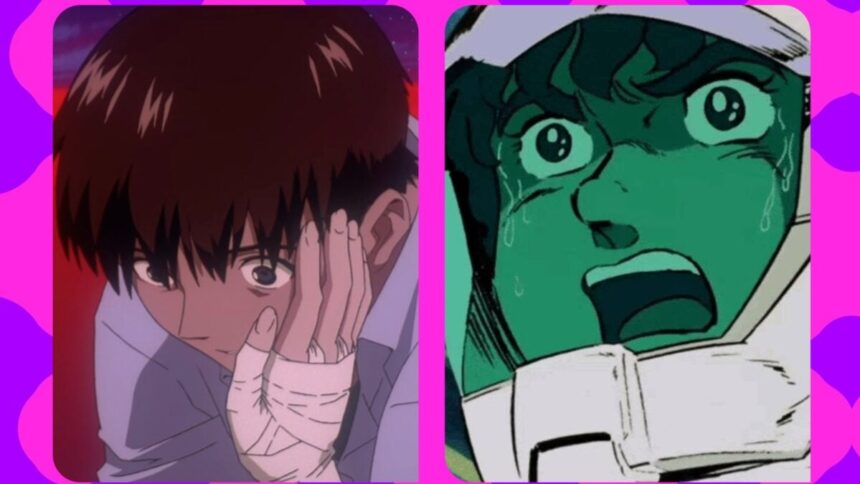
This, textually, is not all that different from the setup of Evangelion. There, young teen boy Shinji Ikari is forced to pilot a giant robot called an Evangelion by his father, Gendo Ikari, who is the head of the organization that built the Evas and is using them for extremely complicated purposes that aren’t super relevant here. Over the course of Mobile Suit Gundam, Amuro becomes increasingly impacted by the war, both from having to kill enemies in battle and from the near-constant danger he and his friends are in. At a certain point near the end of the series, he is completely emotionally broken and barely able to function until the love of his friends—and the definitely platonic feelings he shares with his enemy rival—snap him out of it.
Shinji, by comparison, hits complete emotional devastation almost immediately and any recovery he makes is fully undone by the time he’s visiting fellow Eva pilot Rei’s hospital room at the beginning of End of Evangelion (it’s a memorable scene). If Gundam took the old super robot fantasy of the kid who gets to save the day with a big robot and explored how it might actually impact the psyche of an impressionable youth, then Evangelion pushed it so far that the emotional impact turns into genuine horror. Amuro’s life is sort of ruined by war, but he has friends and he’s more or less okay at the end—not counting that the demand for Gundam sequels meant he spent his whole life fighting with big robots. For Shinji, everything and everyone around him becomes a nightmare and he has to wrestle with the basic question of whether or not all life is worth it.
But it’s not just the big robots that mess these kids up: It’s also their fathers. Tem Ray is largely absent from Gundam after Amuro joins the war effort, having been sucked into space early in the story, but Amuro is joyfully reunited with his dad later on in the show. After spending so much time in battle with nobody but other soldiers, Amuro is happy to see his father again… until it turns out that being sucked into space left him with brain damage and he’s now even more obsessed with the Gundam and even less interested in his son as a person.
If Tem is a bad dad, Gendo is the worst dad. He needs Shinji for his schemes and machinations, but his schemes and machinations don’t require him to see Shinji as much of a human being. He’s just as much of a tool as the Eva he pilots. It’s an escalation of what Gundam does, making part of Amuro’s emotional arc (the rejection and absence of his father, plus his horror at the way he’s being used) into the literal text of the story.
In 2025, some of the people who made Evangelion got a chance to pay proper homage to Gundam with the brilliant Mobile Suit Gundam GQuuuuuuX. Set in an alternate-universe version of the original Gundam timeline, the show was a collaboration between regular Gundam production company Sunrise and Hideaki Anno’s Studio Khara—specifically including staff who had previously worked on Evangelion. The show is largely about reckoning with the legacy of Gundam and building a new story on top of it, so it could even be read as a literal expression of the relationship between the two anime. The show’s main Gundams even have teeth like Evas, and the design of one Gundam seems like an explicit nod to the iconic purple-and-green color scheme of Eva Unit 01. Put simply: They knew what they were doing.
Neon Genesis Evangelion is a masterpiece, well-deserving of its inclusion on the Criterion Channel, but it didn’t just appear on Japanese televisions out of nowhere in 1995. In addition to Hideaki Anno learning from Hayao Miyazaki (he worked on the unforgettable “Giant Warrior” sequence in Nausicaä of the Valley of the Wind, which is itself very Evangelion-coded), Eva built on, and learned from, some of the best anime of all time.
Want more io9 news? Check out the best movies and TV shows to stream this month and all the upcoming sci-fi, fantasy, and horror books that should be on your radar.
Read the full article here