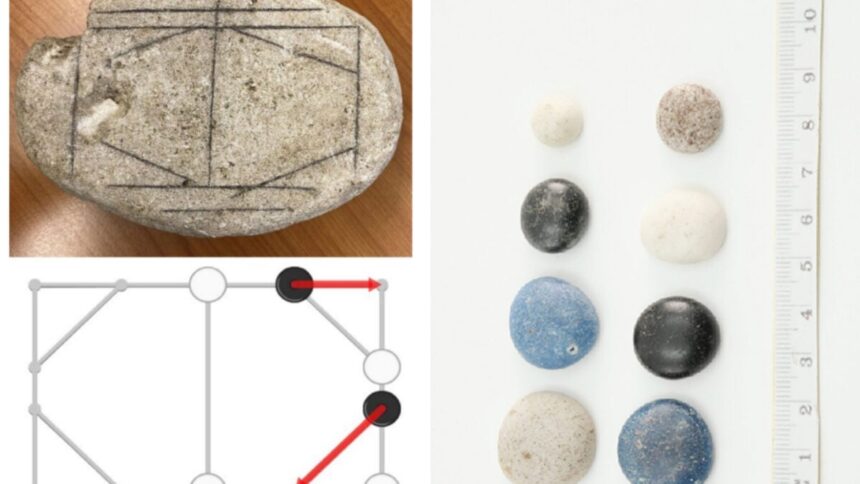
These days, artificial intelligence can take notes during doctor appointments, boost your confidence in school, and help detect cancer (though LLMs are bad at reading clocks). Now, new research has turned to AI to understand a potential ancient game board.
In the hands of a non-expert, the oval artifact doesn’t look like much of anything. However, geometric patterns on one of its two broad sides, along with other clues, suggest it to be a stone board game. In a study published today in the journal Antiquity, researchers used artificial intelligence to test this theory, as well as identify what the game rules may have been.
Those who came before us enjoyed board games, just like we do; the pastime dates back to the Bronze Age, at least. The problem, however, is that the components of many of these games were not nearly as enduring as Monopoly’s houses and hotels will surely prove to be. As such, the stone object that came to light in Coriovallum—a Roman town in modern-day Netherlands—could be a rare opportunity to investigate ancient nerds.
A mysterious ancient game
“We identified the object as a game because of the geometric pattern on its upper face and because of evidence that it was deliberately shaped,” Walter Crist, lead author of the study and an archaeologist at Leiden University specializing in ancient board games, explained in an Antiquity statement. “Further evidence that it was a game was presented by visible damage on the surface that would be consistent with abrasion caused by sliding Roman-era game pieces on the surface.”
There’s only one problem. The aforementioned geometric pattern doesn’t align with any game known to researchers. To investigate the matter, Crist and his colleagues did what many people faced with a question tend to do these days—they asked AI to give it a go. Given the artifact’s human-caused abrasions, the team used AI to model potential game rules.
“The damage was unevenly distributed along the lines of the board,” Crist said. “We sought to answer the question of whether we could use AI-driven simulated play as a tool to discover playing rules that would replicate this disproportionate pattern of use wear on the surface of this board with rules similar to those documented for other small games in Europe, thus confirming that the object was likely to have been a game board.”
AI vs AI
The researchers had two AIs play a large number of ancient European board games, including Scandinavia’s Haretavl and Italy’s Gioco dell’orso, until they landed on one that could have caused the stone board’s wear-and-tear.
This approach ultimately revealed a match with blocking games, a kind of board game whose objective consists of blocking the other player’s movement (just like Ticket to Ride, if you play like my fiendish partner). It also bolsters the preexisting theory that the artifact was a board game after all.
“This is the first time that AI-driven simulated play has been used in concert with archaeological methods to identify a board game,” Crist concludes. “This research provides archaeologists with the tools to be able to identify games from ancient cultures that are unusual or uncommonly played, since current methods for identification rely on connecting the geometric patterns that make up the playing surface to games that are known today from references in text, or from artistic representations of them.”
Interestingly, previously known traces of blocking games only appeared in Europe starting in the Middle Ages and are overall very rare in the region. In other words, the study suggests that people may have played these types of games centuries earlier than researchers thought.
All that’s left to discover is how many tears were shed and friendships broken over the movement—or not—of pieces on this board.
Read the full article here