
While the idea of paying for mods has long been taboo in modding circles, there’s always the occasional modder who tries to cash in. One popular way of monetizing mods these days is via Patreon and similar sites; instead of directly charging for a mod, developers make download links available to people who support them at a given subscription tier.
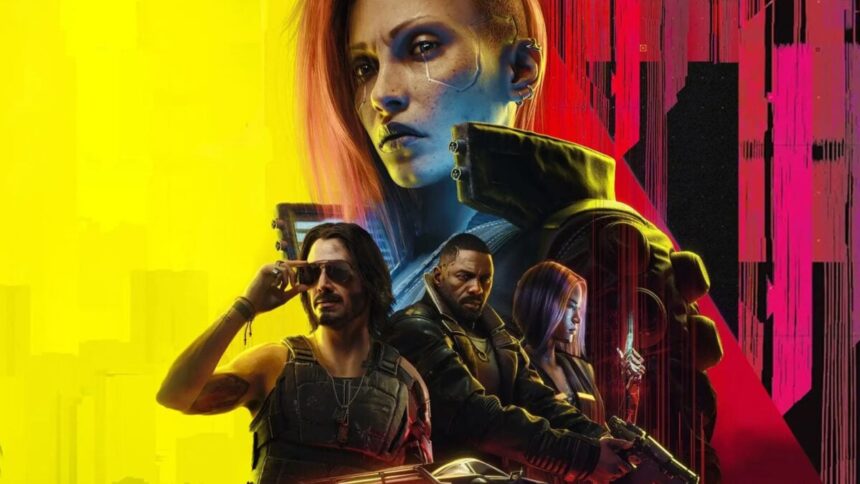
One such developer is Luke Ross—not his real name, apparently—who makes a startling amount of money writing VR ports for games without VR support. Until recently, Ross’s software supported Cyberpunk 2077, but no longer—largely because Ross himself contacted CD Projekt RED, the game’s developer, and offered to license his VR port to them. The company’s response was presumably not what he was hoping for: instead of a big fat contract, he got a big fat DMCA takedown notice.
One of the reasons the whole idea of paying for mods is that many modding communities are perpetually nervous that any suggestion that anyone was making money from modding would result in blanket copyright strikes and takedown demands. This is because most publishers’ Terms of Service specifically forbid third parties from making money from their IP.
CDPR is no different: the company has an entire section of their Terms of Service document dedicated to what they term “Fan Content”, and the first paragraph of Section 2 (entitled “The Golden Rule”) states that “you cannot do anything with our games for any commercial purpose.” The paragraph goes on to make an explicit prohibition for paywalled content: “We’re happy for you to accept reasonable donations in connection with your fan content, but you’re not allowed to make people pay for it or have it behind any sort of paywall (e.g. don’t make content only available to paid subscribers).” (Emphasis ours.)
With the obligatory disclaimer that we are not lawyers, this seems pretty clear-cut. Ross has nevertheless come out fighting, arguing that his software is a general VR application: “It supports a large number of games which were built upon different engines, and it contains absolutely zero code or assets from [CDPR’s] IP.” He argues that “saying [the mod] infringes [CDPR’s] IP rights is equivalent to maintaining for example that [hardware monitoring software] RivaTuner violates game publishers’ copyrights because it intercepts the images the game is drawing on screen and it processes them in order to overlay its statistics.”
Neither of these arguments appear particularly compelling: there is plenty of fan content that contains neither code nor assets taken directly from a company’s game, but would still be considered “Fan Content” under CDPR’s Terms of Service. RivaTuner is a curious example to choose, given that it’s freeware, and displaying an FPS counter in the corner of a screen is obviously very different than providing a game-specific VR experience. A more interesting comparison here is Boris Vorontsov’s (free) ENB Series, a post-processing plugin that supports a large number of games but requires specific tuning for each title.
As per a statement to IGN, Ross’s software appears to be similar. In response to a question about making the mod free, he said, “My software supports 40+ games and various completely different engines, which makes creating a version that specifically supports only Cyberpunk 2077 a non-trivial task.” The fact the mod requires specific engine- and title-related code rather undermines the argument that it is generic software in the same way as RivaTuner. The very fact that people are paying or not paying for the software on the basis of its support for Cyberpunk 2077 also feels relevant.
There are larger questions here, including whether or not modders should be able to make money from their work, and whether EULAs and Terms of Service agreements are overly restrictive and/or have a solid legal basis. Those questions are certainly valid and worth discussing, but contacting a company and attempting to that company them a product that certainly looks for all the world like it’s in flagrant violation of its IP rights feels … naïve, at best. The complaints that CDPR had not contacted or negotiated with him rather begs the question of why he expected any differently; he’s not exactly negotiating from a position of strength here.
And the situation appears to have blown up in his face: since the mod was removed from Patreon, bereft VR enthusiasts have been sharing it. For free. “In a sense,” Ross said to IGN, “CDPR already got what they wanted.”
Read the full article here