Astronomers have spent nearly a century searching for dark matter, the invisible scaffolding thought to hold galaxies together. While there’s abundant indirect evidence to suggest this mysterious substance exists, no one has been able to detect it directly. Now, a new study might finally signal a breakthrough.
Using data from NASA’s Fermi Gamma-ray Space Telescope, astronomer and University of Tokyo professor Tomonori Totani is claiming to have identified gamma-ray emissions that appear to have originated from dark matter. His findings, published Tuesday in the Journal of Cosmology and Astroparticle Physics, suggest this radiation was emitted by colliding WIMPs (weakly interacting massive particles).
“WIMPs, a leading candidate for dark matter, have long been predicted to annihilate and emit gamma rays, prompting numerous search efforts,” Totani told Gizmodo in an email. “This time, using the latest Fermi satellite data accumulated over 15 years and a new method focusing on the halo region (excluding the galactic center), I have discovered gamma-ray emissions believed to originate from dark matter.”
It’s an intriguing finding, but experts we spoke to remain unconvinced, warning that the signal could be a case of cosmic noise mistaken for dark matter or yet another frustrating false positive.
Totani himself emphasizes that it’s too early to definitively say these gamma rays originated from dark matter, but their characteristics suggest they could have. Based on his findings, they don’t look like those that originate from conventional astronomical sources. “At the very least, it represents the most promising candidate radiation from dark matter known to date,” he said.
Finding a needle in a cosmological haystack
Astronomers believe dark matter exists because no observable matter in the known universe can explain certain gravitational effects, such as the unexpectedly rapid rotation of galaxies or the fact that they’re held together more tightly than they should be.
Dark matter is the theoretical answer to this cosmological conundrum, but if it exists, its particles clearly do not absorb, reflect, or emit light. If they did, astronomers would have detected this abundant substance long ago.
WIMPs largely fit that description. Astronomers believe WIMPs interact through gravity, but their interactions with electromagnetic and nuclear forces are too weak to detect. When they collide with each other, however, they should theoretically annihilate and emit gamma rays.
Researchers have hunted for these gamma-ray emissions for years, targeting regions of the Milky Way where dark matter appears to be concentrated, such as the galactic center. These searches have come up empty, so Totani decided to look elsewhere, specifically the galaxy’s halo region.
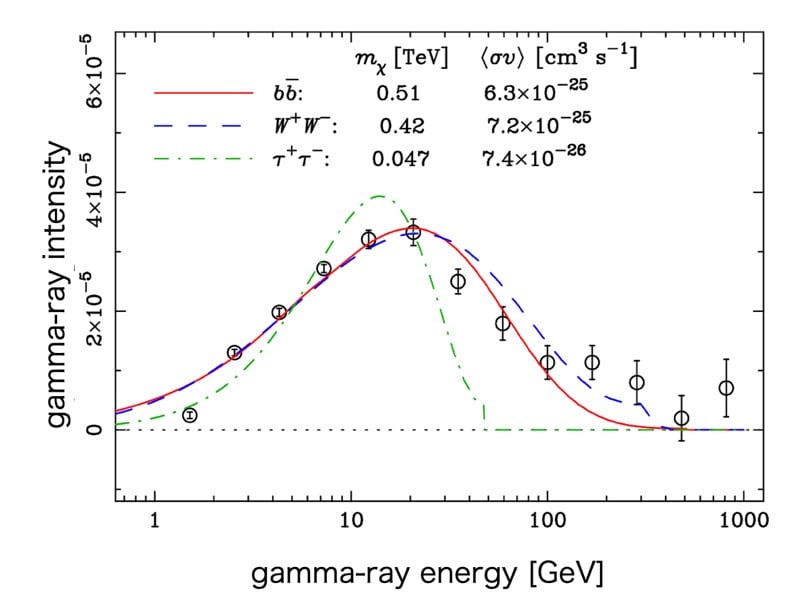
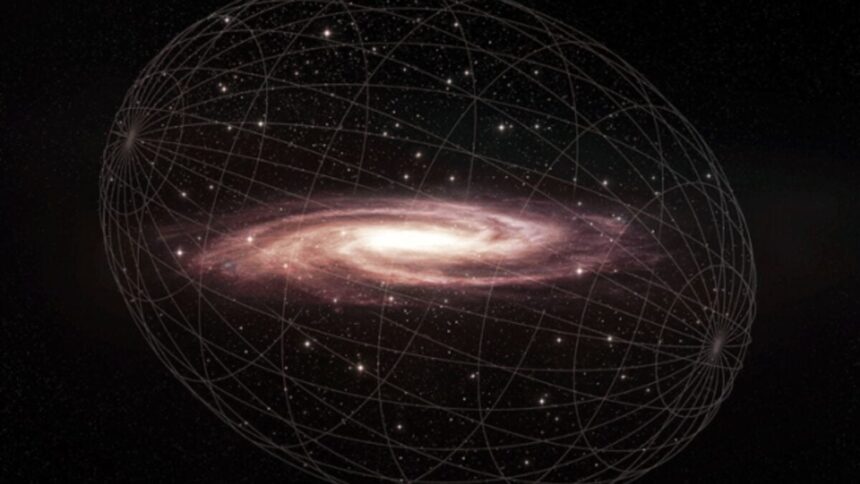
This extended, roughly spherical region surrounding the Milky Way’s galactic disk contains stars, gas, and presumably a large amount of dark matter. By analyzing Fermi satellite observations of the halo, Totani identified high-energy gamma ray emissions that align with the shape expected from the dark matter halo.
The range of gamma-ray emission intensities he observed matches what astronomers would expect to see from WIMP annihilation. Totani also estimated the frequency of WIMP annihilation from the measured gamma-ray intensity, and this also fell within the range of theoretical predictions. That raises the possibility that he may have detected a signal produced by dark matter WIMPs.
Case closed? Not yet
The findings are encouraging, but Totani and other experts caution that these gamma rays aren’t a smoking gun.
“The problem is that there’s lots of ways to make gamma rays, everything from pulsars to matter inspiraling to black holes to supernovae,” a Fermilab physicist told Gizmodo. “Heck, we get gamma rays off the Sun.”
Fermilab officials asked Gizmodo to refrain from naming the scientist who provided these quotes.
What distinguishes the gamma rays Totani detected from most others is how energetic they are, with a photon energy of 20 gigaelectronvolts. That’s “pretty hefty,” but not totally unheard of, the Fermilab physicist explained. “There are very highly energetic things in space, and those highly energetic things can make high-energy gamma rays.”
While the gamma emissions Totani detected appear to fit the description of those that would be produced by WIMP annihilation, there are other possible explanations that must be ruled out first, according to the Fermilab physicist. These could include high-energy phenomena such as neutron star collisions or solar wind emanating from pulsars, they explained.
Additional studies will also need to validate Totani’s observations and calculations. “The decisive proof will be the detection of gamma rays from other regions of the sky with the same dark matter parameters,” Totani said. “I hope these results will be verified by independent analyses conducted by other researchers.”
With that said, Dan Hooper, a professor of physics at the University of Wisconsin-Madison and director of the Wisconsin IceCube Particle Astrophysics Center, points out that many other scientists have already analyzed the Fermi satellite data Totani used, and none have detected the excess gamma ray emissions he did.
“Now, some different choices were made, and I’m glad people are trying different things, but it doesn’t leave me very confident that this is an authentic signal of dark matter,” Hooper told Gizmodo.
For one thing, Totani did not look for gamma rays anywhere within 10 degrees of the galactic center. Though this approach could provide some benefits, avoiding the galactic center may have swayed the findings, as this region of our galaxy is where physicists expect a big part of the dark matter signal to come from, Hooper explained.
He also suspects that the high-energy gamma ray emissions Totani detected may actually be an artifact of the analysis. This could result from using a background model that is absorbing too much of the emission at low energies, creating the illusion of a high-energy excess.
The bottom line is that “Dark matter is very difficult to find, it is very difficult to characterize,” the Fermilab physicist said. “Nobody should believe it without several mutually validating lines of evidence, and this is just one.”
So, the search for dark matter continues. Whether future studies confirm or undermine Totani’s findings remains to be seen, but either way, they will help researchers refine our understanding of the invisible matter that shapes our universe.
Read the full article here