

If you’ve ever been on a plane, you’re probably familiar with what cloud tops look like: generally white and fluffy, with dips of blue-gray here and there. But the physics behind cloud tops had long puzzled scientists—until now.
At Brookhaven National Laboratory’s facilities in Long Island, New York, researchers have developed a new type of lidar—a laser-based remote sensing device. This lidar captures fine details of cloud structures at a scale of roughly 0.4 inches (1 centimeter), making it 100 to 1,000 times clearer than traditional instruments. For a recent study published in Proceedings of the National Academy of Sciences, Brookhaven and collaborators paired this lidar with chamber experiments.
This is the first experimental description to differentiate water structures in cloud tops and interiors—features that, in turn, dictate how clouds “evolve, form precipitation, and affect Earth’s energy balance,” the researchers explained in a statement.
‘A microscope for clouds’
According to the researchers, the new lidar provides “ultra-high-resolution” images into cloud dynamics. Impressively, the lidar detects and counts individual photons—massless, light-carrying particles—bursting out of a cloud hit by ultrafast laser pulses.
Then, a custom data-sampling algorithm translates the photon signals into a profile of the cloud structure. The lidar is “essentially a microscope for clouds,” Fan Yang, study lead author and a Brookhaven researcher, said in the statement.
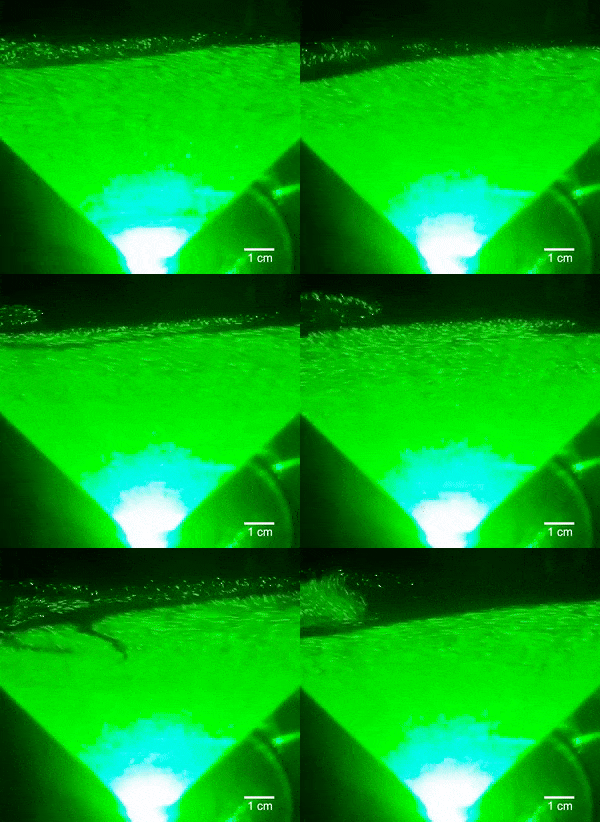
The team took its device to a cloud chamber in Michigan, where the researchers could artificially generate clouds under temperature and humidity conditions of their choice. This allowed them to document the precise physics of how cloud droplets are distributed throughout a cloud.
What they found was that, surprisingly, existing models fell short when it came to describing cloud physics. Specifically, the lidar measurements revealed a high variation of cloud droplet distribution at the top, whereas things were more uniform throughout the rest of the cloud.
Turbulent cloud physics
The researchers believe this may be due to two processes, entrainment and sedimentation. Entrainment draws the clear, dry air above the cloud downward, resulting in a spotty distribution of droplets on the uppermost layer of the cloud. At the same time, sedimentation automatically sorts droplets according to size so that heavier droplets fall faster into the clouds compared to lighter ones.
Meanwhile, the bulky cloud interior typically experiences strong turbulence, so the droplets immediately blend together in a uniform manner. In comparison, cloud tops have much weaker turbulence, so only relatively small droplets stay suspended in that region of the cloud.
“Many atmospheric models either neglect droplet sedimentation altogether or represent droplets of different sizes with a single fall speed,” Yang explained. “This simplification is reasonable in the bulk region of the cloud, where turbulence is strong, but it breaks down near the cloud top, where turbulence is weaker.”
Tracking the silver lining
The new findings have significant implications for atmospheric science, the researchers argue in the paper. For instance, inaccurate representations of cloud-top physics can “introduce substantial uncertainty into model predictions of how clouds reflect sunlight and trigger rainfall,” Yang said.
The researchers hope the lidar could eventually be used to directly measure clouds in the real atmosphere, in addition to refining current models. After all, they admitted, a cloud chamber isn’t the perfect representation of real-life cloud dynamics—although technological advances have allowed researchers to come impressively close.
Read the full article here