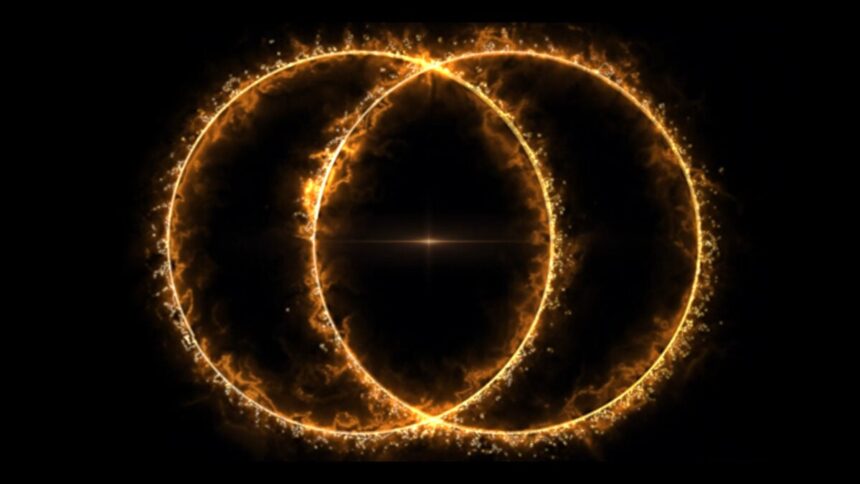
For lovers of cool astronomy and math, this finding is a real treat. Citizen astronomers stumbled upon not one but two rings of extragalactic radio signals crossing each other to form a near-perfect Venn diagram.
A paper published October 2 in Monthly Notices of the Royal Astronomical Society identifies this strangely geometric object as an “odd radio circle” (ORC), vast rings of magnetized plasma. These rings, only visible at radio wavelengths, emit non-thermal synchrotron radiation. They’re also gigantic, typically spanning hundreds of thousands of light-years. Astronomers have only documented a small handful of cases, but this particular pair of rings is reportedly the most distant and most powerful so far.
What’s more, the researchers found two more powerful radio signals that offer valuable information about the dynamics of ORCs, first discovered six years ago.
“ORCs are among the most bizarre and beautiful cosmic structures we’ve ever seen—and they may hold vital clues about how galaxies and black holes co-evolve, hand-in-hand,” said Ananda Hota, study lead author and founder of the RAD@home Astronomy Collaboratory for citizen science research, in a statement.
An ongoing puzzle
As the name suggests, odd radio circles are only visible to radio telescopes, which operate at comparatively low frequencies. At other frequencies, or wavelengths, they become invisible—one reason they only recently came into view, owing to advances in radio astronomy.
Given their novelty, astronomers have yet to pinpoint an exact cause for odd radio circles. The handful of detections so far have suggested they could be shockwaves from merging galaxies or black holes, or even the remnants of supernovas. Either way, ORCs almost always materialize near large galaxies, hinting there should be some correlation between the two.
The new discovery raises another possibility. What if these rings are the product of “superwinds” compressing dormant radio lobes? Galactic superwinds can emerge from a variety of powerful extragalactic events, which could explain why past ORC observations had conflicting sources.
Many moving parts
The other two radio signals that the researchers found nearby also support this hypothesis. Specifically, these were two gigantic galaxies in a crowded galaxy cluster that were blasting out powerful jets of plasma and radio emissions. Their activity, coupled with the local environment, likely helped shape the rings, the researchers said.
“These discoveries show that ORCs and radio rings are not isolated curiosities,” noted Pratik Dabhade, study co-author and an astronomer at the National Centre for Nuclear Research in Poland, in the statement. “They are part of a broader family of exotic plasma structures shaped by black hole jets, winds, and their environments.”
The signals were first detected by citizen scientists using the Low Frequency Array, a sensitive radio telescope based in Europe. Professional scientists associated with the RAD@home Astronomy Collaboratory helped assess and confirm the validity of their findings.
“The fact that citizen scientists uncovered them highlights the continued importance of human pattern recognition, even in the age of machine learning,” Dabhade added.
Read the full article here