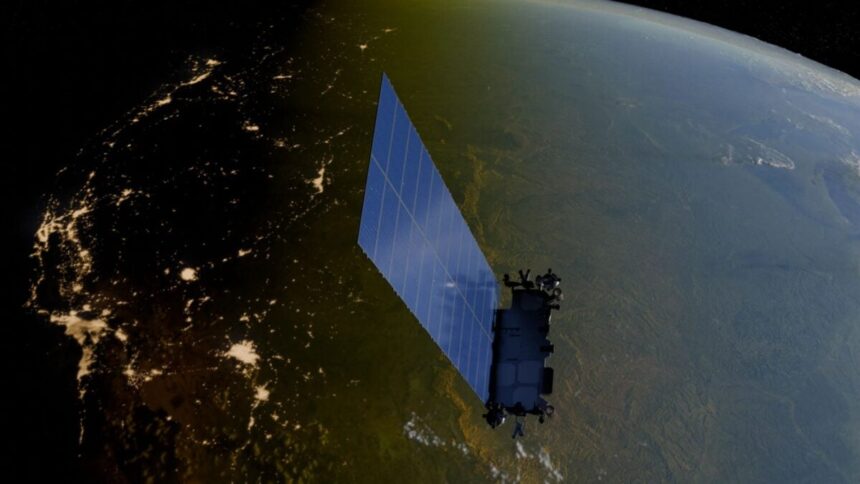
Low-Earth orbit is getting a little crowded. As operators around the world launch more satellites and spacecraft each year, there is an urgent need to prevent collisions like the one a Starlink satellite narrowly avoided last week.
That close call followed the launch of a Chinese Kinetica 1 rocket on Tuesday, December 9, from the Jinquan Satellite Launch Center in the Gobi Desert. The rocket deployed nine satellites, one of which nearly crashed into a Starlink 350 miles (560 kilometers) above Earth, according to Michael Nicolls, vice president of Starlink engineering.
“When satellite operators do not share ephemeris for their satellites, dangerously close approaches can occur in space,” Nicolls posted on X Friday. He explained that, to his team’s knowledge, Kinetic 1’s launch operator did not take the necessary precautions to prevent collisions with satellites already in orbit, resulting in a 655-foot (200-meter) close encounter between one of its deployed satellites and a Starlink.
“Most of the risk of operating in space comes from the lack of coordination between satellite operators—this needs to change,” Nicolls wrote.
Coordination is key
The events that took place between Kinetica 1’s launch and this incident remain unclear. In response to Nicolls’s X post, CAS Space (the company that operates Kinetica 1) stated that its team is in contact with Starlink and that “[a]ll CAS Space launches select their launch windows using the ground-based space awareness system to avoid collisions with known satellites/debris.”
In a subsequent post, CAS Space wrote: “If confirmed, this incident occurred nearly 48 hours after payload separation, by which time the launch mission had long concluded. CAS Space will coordinate with satellite operators to proceed. This calls for re-establishing collaborations between the two New Space ecosystems.”
Gizmodo attempted to contact CAS Space for further comment but could not reach the company. Gizmodo also reached out to China’s Ministry of National Defense, which handles public communication for the People’s Liberation Army and subsequently the Jinquan Satellite Launch Center, but the Ministry did not respond by the time of publication.
No matter what went down in orbit last week—or who’s to blame for it—both Nicolls and CAS Space are right. The more congested LEO becomes, the greater the need for communication and collaboration between satellite operators.
Starlink will be a central node in this emerging network. The constellation of more than 9,300 operational Starlinks makes up the majority of all active Earth-orbiting satellites, according to Harvard University astronomer Jonathan McDowell, who tracks the number of spacecraft in LEO.
The growing threat of Kessler Syndrome
Each Starlink satellite maneuvers to avoid collisions almost 300 times per day, Space.com reported in 2024. That’s nearly double the number of daily maneuvers the satellites performed in 2023.
SpaceX has no plans to slow down Starlink launches anytime soon. In fact, the company is planning a major ramp-up in 2026, focusing on mass deployment of its third-generation Starlinks using Starship. Meanwhile, other operators such as Amazon LEO and Viasat will continue to launch their own satellites. Just imagine how crowded Earth’s orbit will be in a few years.
This has prompted warnings about Kessler syndrome, a hypothetical scenario where the density of objects in LEO becomes so high that collisions begin to snowball out of control. Some experts believe we are already in the very early stages of this process.
With no end in sight to the surge in satellite deployment, the best strategies for avoiding this worst-case scenario are improving collision-avoidance systems and communication between operators. Without effective coordination, the next close encounter probably won’t be a miss.
Read the full article here