

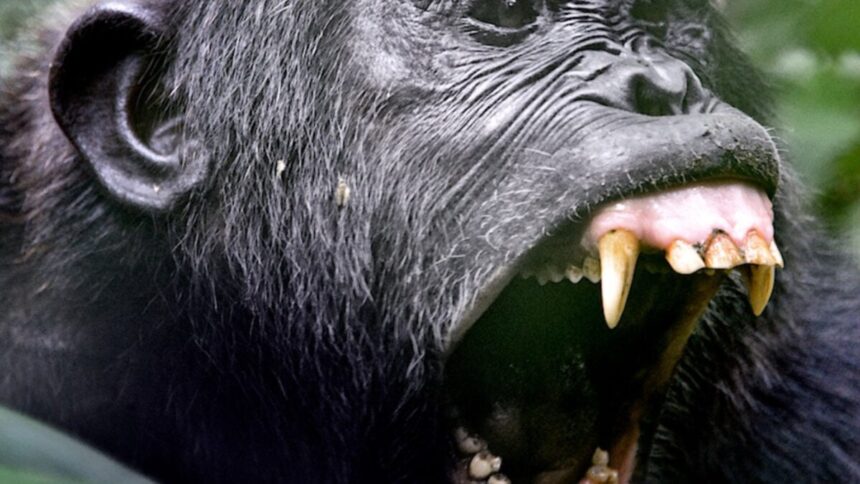
For two decades, a community of chimpanzees in Uganda thrived together. Then the group turned into two, and one started massacring the other.
The largest group of wild chimpanzees known to researchers, the Ngogo chimpanzees of Kibale National Park, has devolved into a shocking state of violence. Since they completely fissioned (i.e., broke apart) in 2018, members of the smaller of the two communities have killed 24 individuals—adult males as well as infants—in the larger one, whose lack of retaliation is further perplexing the already confused researchers. The troubling study, published today in the journal Science, could have implications for understanding human conflict.
Researchers have been studying these chimpanzees for over 30 years, and during the first 20 years, the group thrived. Their numbers increased, which made the community stronger. But that doesn’t mean there wasn’t any violence. In fact, the chimpanzees worked together to attack their neighbors. They killed a significant number of them and took over their territories, giving them access to more food. A PNAS study from last year showed infant survivorship and female fertility went up in the wake of the Ngogo chimpanzees’ land and food gains.
“There are all these benefits that they were gaining by working together as a collective group. So after documenting this for so many years, it did come as a surprise to me, as well as I think everybody else that has worked with these chimps, when this process of them splitting started to occur in 2015,” John Mitani, primate behavioral ecologist at the University of Michigan, told Gizmodo. Permanent splits in chimpanzee communities in general are exceedingly unusual—genetic analyses indicate that they only take place around every five centuries.
“The findings reported in this paper are difficult for me to come to grips with because these are chimpanzees that I’ve studied for 30 years. I’ve known many of them for their entire lives. And now I’m watching them kill each other,” he added.
Not your usual bloodshed
It’s not the bloodshed on its own that’s surprising. That chimpanzees are extremely xenophobic is a well-established fact, explained Mitani, and it’s common for them to kill members of rival groups. What’s not normal is killing former groupmates. Males never leave their group, and so they’re killing individuals with whom they have shared their whole lives.
The question is, why? Mitani, who co-authored both studies, explained that the separation was likely due to a mix of things, including the group becoming too large—it peaked at more than 200 group members. In fact, such fissions in primate species groups often take place when they become too big. The increase causes feeding competition to intensify, and splitting lessens that competition. The Ngogo chimpanzees’ growth likely also aggravated reproductive competition.
The rise of a new alpha male in 2015, as antagonisms began to explode, is another possible factor. Observations of other chimpanzee groups have revealed that increased aggression takes place in the wake of changes in the male dominance hierarchy, according to Mitani. The males’ social relationships shift, and the entire dynamic may have contributed to the internal conflict. Furthermore, the group’s split started one year after a number of adult males had died—individuals who may have played a role in maintaining the big group together.
Chimpanzees participate in “fission-fusion” social dynamics that see individuals spend time with different subgroups throughout the day. As such, “they can go days, weeks, maybe months without seeing some of the chimps in their group,” Aaron Sandel, co-author of the new study and co-director of the Ngogo Chimpanzee Project, told Gizmodo. “But what we witnessed is very different. The group became polarized. What had once been neighborhoods within a cohesive group became separate groups. And they divided the territory in two.”
The smaller of the two groups, known as the Western group, then began attacking the Central group. This is confusing because a larger group should be able to leverage its numerical superiority and attack the smaller one. But it gets even weirder—only the Western group has been on the attack. In fact, the Central group hasn’t retaliated, not even when they dramatically outnumbered their killers at the beginning of the ordeal. “They have failed to fight back and suffered as a consequence,” Mitani said.
Implications for humans
So what does this mean for humans? Sandel points out that chimps don’t have ethnicities or religions, two elements that humans frequently blame for causing civil wars. While he emphasizes that the Ngogo chimpanzee situation isn’t a civil war, Sandel believes the conflict must be solely driven by shifting relationships.
“Cultural markers of group identity are, no doubt, implicated in human wars, including civil wars. But it’s possible that these big cultural divisions are secondary, and interpersonal dynamics are primary—friendships, cliques, rivalries. It’s a hypothesis to be tested,” he explained. “But if it’s true that conflicts in humans are driven by interpersonal dynamics, then our strategies for conflict resolution need to be focused on interpersonal dynamics.”
The “study suggests that cultural differences may not be as important for [human] war as we have thought,” Boston University anthropologist Luke Glowacki agreed, though he points to a different factor. “Rather, deep and basic evolutionary processes have a role in human warfare,” Glowacki, who did not participate in the study, told Gizmodo.
For Mitani, however, the study offers an opportunity to reflect on the differences between humans and chimpanzees. “We split off of them six to eight million years ago, and since then, we’ve changed in important ways,” he emphasized. Humans are an “unusually cooperative species,” Mitani explains. “For the most part, we’re able to live peaceably side by side with each other in a world where there are over eight billion people. That’s a stark difference between chimps and humans and something that gives me hope, especially in this time of increasing polarization.”
In my opinion, it’s about time people remembered how to be unusually cooperative again.
Read the full article here