Music nerds and lovers of fascinating inventions, rejoice! The 10 finalists in Georgia Tech’s annual Guthman Musical Instrument Competition were announced recently, and they’re just as weird and wonderful as we’ve come to expect. The competition offers a $10,000 prize for “the newest and greatest ideas in music.” In 2017, the Guardian called it “the Pulitzer of the new instrument world,” and it’s proven to be a pretty reliable source of talent over the 28 years that it’s been operating, with several past winners having gone on to found successful music companies like Roli and Teenage Engineering.
This year’s winner will be announced in mid-March, and in the meantime, the competition’s website has short videos of all 10 finalists’ entries.
One of the most pleasing aspects of this year’s competition is the diversity of the finalists’ creations. Some are genuinely new and innovative instruments that either fill an existing niche or carve an entirely new one. Take, for instance, the “Gajveena” (above), which, as inventor Debjit Mahalanobis explains, “is a combination of two of the lowest-pitched instruments in the world.” (The instruments in question are the double bass and the rudra veena.) The resultant instrument looks kinda like a double bass that has been retrofitted with the fretboard from a sitar, and Mahalanobis uses it with both bow and fingers to create a striking variety of low-end sounds.
It’s not the only string instrument on show, either, although the “EV”—a sort of hybrid acoustic/electronic viola—takes a very different approach to the task of producing something new. As per designer Brian Lindgren’s website, the instrument arose from a “desire to create an electronic musical instrument for string players that retained the sense of embodiment and detailed nuance of sound generation that string players are accustomed to.” Several other entries also combine the acoustic and electric: the “Post-Digital Sax” takes the acoustic sound created by the player’s breath and manipulates it digitally in real time, while the “Kalíptera” creates beautiful ambient drones from two resonance boxes and a gyroscope.

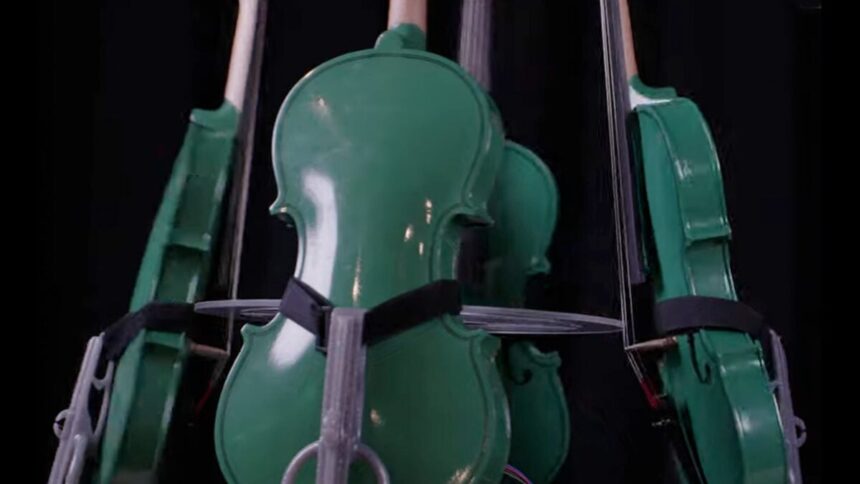
Other entries are more outlandish and/or conceptual. There’s something called the “Demon Box” (above), which picks up and amplifies the frequencies of the electronic devices that surround us and form part of our everyday lives—and in doing so, reveals how many quotidian devices turn out to have very distinctive electromagnetic signatures. (If you’ve never heard a man play an impact driver, have you even really lived at all?) A project called “The Amphibian Modules” is a modular synthesizer where the patching is done by submerging electrodes in a saline solution, while “Fiddle Henge” mounts four violins on a motorized bass drum, with suitably cacophonous results.
Some entries combine high concept and function to an interesting effect. The “Lethelium,” a two-octave chromatic instrument that recalls a hammer dulcimer and is constructed from a bicycle wheel, comes with an entire narrative that involves “a cyberpunk zombie story where survivors create weapons, armor, tools, and even instruments out of bike parts”. The “Verto“ (above) is a piano-esque device based around the use of spinning tone wheels, which generate sound via a special glove that has pickups mounted to the fingers. And finally, the ambitiously-named “Masterpiece” is a controller that aims to increase accessibility by placing an octave’s worth of color-coded notes in a circle, as well as providing tactile overlays to alter the resultant sound’s timbre.
Honestly, all the instruments are pretty impressive, but if we were forced to choose a favorite, it’d probably be Mahalanobis’s gajveena, just because of the remarkable diversity of bass sounds it produces, its connection to the fascinating world of dhrupad, and the way it bridges the traditions of Indian and Western classical music. But seriously, check out all the entries, because they’re all really cool.
Read the full article here