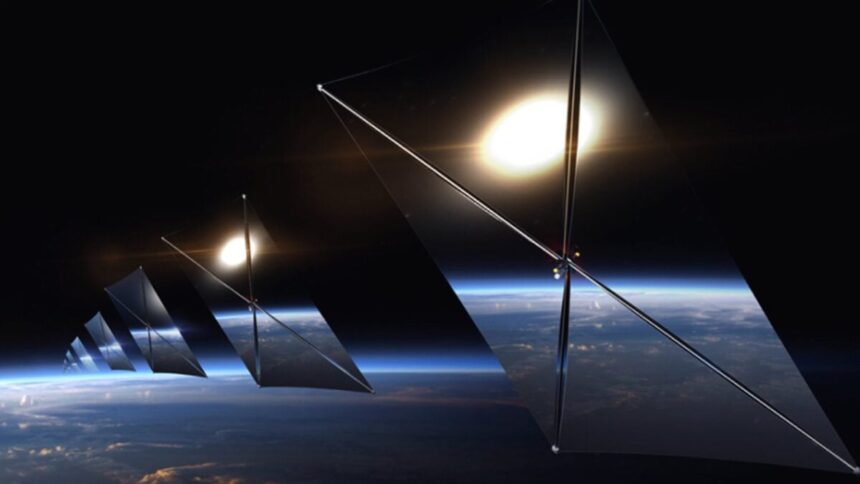
A new startup has come up with a way to sell sunlight on demand, proposing a constellation of satellites that would reflect beams of light onto Earth.
Reflect Orbital wants to deploy up to 50,000 in-space mirrors mounted on satellites to create sunlight after dark, The New York Times reported. The California-based startup has applied to launch a 59-foot-long (18 meters) prototype satellite named Earendil-1 later this year to test its idea, with hopes to be able to illuminate dark areas at a steep price.
Astronomers are deeply concerned that the proposed constellation poses significant risks to the night skies, which have been severely compromised by the thousands of satellites already in Earth orbit.
Sunlight after dark
The idea is fairly simple: bouncing sunlight off a mirror and reflecting it onto a designated area. The scale, however, is enormous.
Reflect Orbital would use its satellite constellation to illuminate areas up to 3 miles (5 kilometers) at a time with intensities ranging between 0.8 and 2.3 lux. By comparison, a full Moon provides an illumination of around 0.05 to 0.3 lux on a clear night.
The company wants to use its technology to illuminate disaster zones and search-and-rescue missions, extend working hours for industrial sites, boost agricultural yields and extend cycles, reduce light pollution by replacing city lights, and provide light for defense operations, according to Reflect Orbital’s website.
All this extra sunlight comes at a price. Reflect Orbital envisions charging about $5,000 per hour for the light of a single mirror in space and potentially splitting the revenues earned by solar farms from the electricity they would generate using the satellite constellation.
Death to night skies
The proposed constellation of in-space mirrors sounds equally ridiculous and hazardous. The light from the illuminated satellites would largely disrupt ground-based astronomical observations and create persistent interference to telescopic imagery. A constellation of its size also has the potential to increase the amount of space debris in Earth orbit and poses an additional risk to orbital collisions.
Astronomy groups dedicated to protecting the sanctity of the night skies are opposed to the idea. DarkSky International issued a statement in response to the proposed constellation, advocating for “transparency, environmental review, and public accountability before any such systems are approved or deployed.”
“Orbital illumination systems represent an unprecedented environmental intervention. Based on current scientific evidence, DarkSky does not see a viable pathway for such systems to align with responsible lighting principles or with our mission to protect natural darkness,” the statement reads. “These systems would introduce significant ecological, human health, safety, and astronomical risks at a global scale.”
Reflect Orbital is awaiting approval from the Federal Communications Commission before it can launch its first satellite. If the company does manage to make its far-fetched idea somehow work, it would have grave consequences for our view of the night skies.
Read the full article here