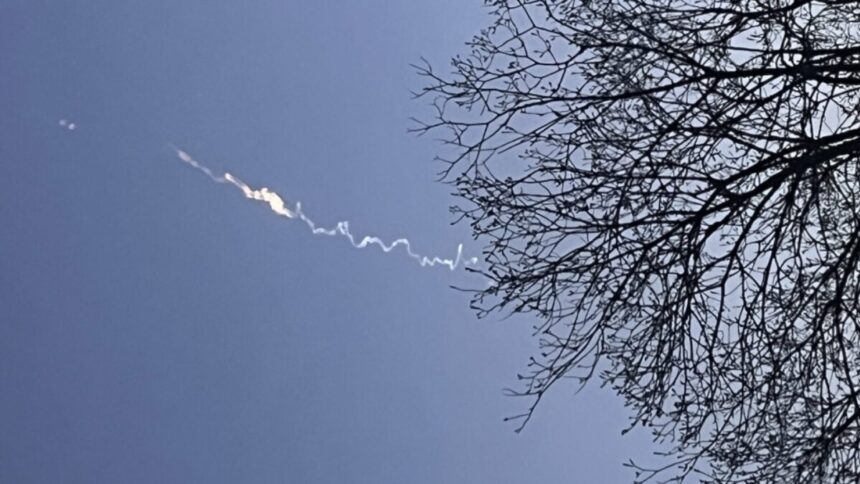
Astronomers are still searching for answers behind this year’s unusual wave of loud and fiery meteor sightings. Over 3,000 people witnessed a slowly disintegrating daytime fireball over Western Europe. Hundreds more reported the sight—and sonic boom—of a 7-ton, 6-foot (2-meter) asteroid screeching above Ohio. March alone has already seen over 40 meteor cases, with yet another ripping through the sky over Texas last Saturday, breaking the sound barrier, before a fragment crashed into a north Houston home and ricocheted around one bedroom like a pinball.
Now, a new analysis published by the American Meteor Society (AMS) on Wednesday has confirmed just how much of a statistical outlier this 2026 barrage has been—as well as early indications of where all these rocks in our solar system might have come from.
“After years of stable baseline activity, something appears to have shifted,” according to AMS researcher Mike Hankey, who manages the society’s fireball reporting tools. “The signal is consistent across multiple metrics.”
According to those metrics—including total witness figures, the number of cases involving sonic booms, and the duration of the sightings—Hankey said, “Fireball activity has increased.”
Extremely loud and incredibly close
Fireballs from outer space, loud enough to produce a sonic boom and witnessed by 50 or more people, have blitzed a trail through Earth’s atmosphere approximately once every three days since this year began, based on reports to the AMS.
“What makes 2026 unique is the combination,” Hankey wrote. “Prior high-sound years like 2021 and 2023 had elevated percentages but moderate event counts. In 2026, both the rate and the absolute count are high.”
Looking at meteor events with the highest number of witnesses—meaning 50 reports or more—30 out of 38 were meteors that were big, tough, and fast enough to produce a sonic boom (79%), which already makes the first quarter of 2026 an outlier historically. But Hankey also determined that the total number of mass sighting events and the volume of those witness reports were outliers, too. Excluding the phenomenal March 8, 2026 case over Western Europe, in which a whopping 3,229 people all reported the same fireball, the remaining 41 episodes so far this March still averaged about 67 witnesses per meteor, “more than double the historical norm,” Hanky noted.
In other words, while the total number of meteor cases has not deviated from researchers’ statistical expectations, the percentage of loud and well-documented cases did.
“Almost half of all March 2026 events with 10+ reports were seen by 50 or more people,” according to Hankey. “Events that would normally draw 25 [to] 49 witnesses instead drew 50, 100, or even 200+ witnesses. The distribution didn’t broaden—it shifted upward.”
Not a new meteor shower, not aliens either (probably)
Hankey cautioned that the AMS data for 2026’s meteor bombardment can only help develop witness-based trajectory estimates, not the more precise trajectories based on instrument data. But the sheer volume of witnesses does help us learn a bit about where these rocks came from.
Activity from a region of space known as the “Anthelion sporadic source,” defined as objects that hit Earth on their way deeper into our solar system toward the Sun, roughly doubled in 2026. A total of 12 meteors traced back to this Anthelion slice of the sky in 2026, with nearly 10 of those events apparently emanating from a single 1,000 square-degree patch.
Several of the biggest meteor events this month were traced back to this Anthelion region—including a March 9 fireball spotted by 282 people across the U.S. eastern seaboard and two fireballs that were reported 381 times over France across the following two days.
For now, Hankey believes that this current data can rule out a few hypotheses for what’s causing this uptick in meteors, or at least meteor sightings.
First, the Anthelion trajectories indicate that there’s no new cluster of asteroids entering Earth’s transit around the Sun—the sort of drifting space rocks that produce predictable annual meteor showers, like the Perseids every August.
Second, early material analyses of the fragments recovered in Ohio and Germany have had the mineral makeup of achondritic HEDs, one of the most common categories of meteorites on record. Hankey concluded that, for these reasons, it’s highly unlikely that any of these fireballs were crashing extraterrestrial spacecraft: “There is no evidence of anomalous trajectory behavior, controlled flight or non-natural composition,” he wrote in the AMS report. (Although, who’s to say aliens wouldn’t want to throw rocks at Earth.)
Hankey speculated that AI-chatbot advice might have helped more people report their sightings to AMS (one potentially very mundane explanation for the volume of reports), but there’s more than enough mystery left to warrant “serious investigation,” in his opinion.
“Whether this represents normal statistical variance,” he said, “an uncharacterized debris population, or something else entirely will require continued monitoring and further analysis.”
Read the full article here