In humanity’s search for life beyond Earth, astronomers have identified more than 6,000 planets that lie outside the solar system. From that long list of worlds of different shapes and sizes, a team of researchers has come up with a list of potential candidates most likely to host alien life.
A new study published in Monthly Notices of the Royal Astronomical Society lists 45 rocky worlds that orbit within a habitable zone, making them more likely to have an essential ingredient for life—water. The list includes some well-known exoplanets such as Proxima Centauri b, TRAPPIST-1f, and Kepler 186f, as well as less popular candidates such as TOI-715 b.
The purpose of the research is to guide astronomers in search of habitability outside the solar system. “While it’s hard to say what makes something more likely to have life, identifying where to look is the first key step—so the goal of our project was to say ‘here are the best targets for observation’,” Gillis Lowry, a graduate student at San Francisco State University, and co-author of the study, said in a statement.
The Goldilocks zone
Astronomers only know of one place in the universe that hosts life—Earth. And so the guidelines for searching for habitable planets are largely based on factors that make our own planet capable of hosting life, such as its position from the Sun, an atmosphere, and surface water.
When searching for Earth-like habitable worlds, astronomers usually look for planets orbiting within the habitable zone. Also known as the Goldilocks zone, it’s an area within which a planet orbits a star where it’s not too hot nor too cold, allowing it to maintain liquid water on its surface and hold onto its atmosphere.
The team behind the new study used data from the European Space Agency’s Gaia mission and the NASA Exoplanet Archive to identify planets in the habitable zone, as well as planets that receive a similar amount of energy from their host star compared to what Earth gets from the Sun.
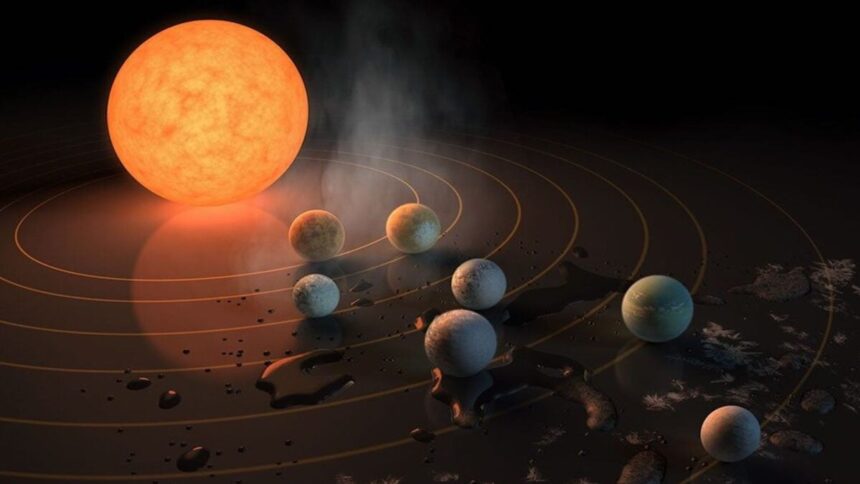
The prime candidates include Earth-sized rocky worlds that orbit around a red dwarf star, named TRAPPIST-1, located 40 light-years away. Four of the seven planets in this star system are found within the habitable zone and are considered potential candidates for hosting liquid water on their surface.
LHS 1140, a super-Earth located 48 light-years away, is another candidate at the top of the list. Recent observations by the Webb space telescope suggest the planet could be a water world with a nitrogen-rich atmosphere, making it one of the most promising habitable zone exoplanets.
Life as we don’t know it
The researchers behind the new study also identified 24 candidates in a narrower 3D habitable zone, broadening the assumptions of how much heat a planet can withstand before it loses its habitability.
That list includes planets with unusual elliptical orbits, receiving varying amounts of heat and radiation as they circle their host stars. Those transiting planets can help astronomers answer the question of whether a planet needs to remain in the habitable zone or can pop in and out of it and still maintain its habitability.
“Observing these planets can help us understand when habitability is lost, how much energy is too much, and which planets remain habitable—or maybe never were,” Abigail Bohl, an astronomer at Cornell University and co-author of the study, said in a statement. “How much orbital eccentricity can a planet have while still holding onto its surface water and habitable conditions?”
The researchers are hoping that the planets they’ve shortlisted will help guide astronomers in the search for alien life, probing the candidate worlds for clues of their habitability.
Read the full article here