Most gamma-ray bursts—the brightest, most powerful explosions in the universe—are tracked back to the deaths of massive stars. But a new discovery suggests that such enormous explosions can come from shockingly tiny galaxies—if the conditions align for particularly dense stars.
In 2023, astronomers using NASA’s Chandra X-ray Observatory and Hubble Space Telescope spotted an unusual class of short gamma-ray bursts, whose origin appeared to be the collision of two neutron stars. Follow-up observations allowed the team to work out the approximate location of the signal’s source: a distant galaxy several billion light-years away. And as far as they could tell, the galaxy seemed rather small for something that hosted such a powerful signal. An analysis of the discovery was recently published in The Astrophysical Journal Letters.
“Finding a neutron star collision where we did is game-changing,” Simone Dichiara, the study’s lead author and an astrophysicist at Penn State University, said in a NASA statement. “It may be the key to unlocking not one, but two important questions in astrophysics.”
Squinting into space
One of these two questions refers to gamma-ray bursts that ostensibly don’t emerge from a galaxy’s core—where star formation is most active—or, in fact, any galaxy at all. The signal, dubbed GRB 230906A, implies that these rogue gamma-ray bursts literally outshine their hosts, such that ground-based observatories aren’t able to realize the smaller, fainter galactic hosts are even there.
Accordingly, when studying gamma-ray bursts, an “accurate X-ray position is crucial to identifying a candidate gamma-ray burst host galaxy that would otherwise be missed or misassigned,” the team notes in the paper. The researchers also considered the possibility that the galaxy was just really far, not necessarily small, but that was a “less likely explanation,” they said in the statement.
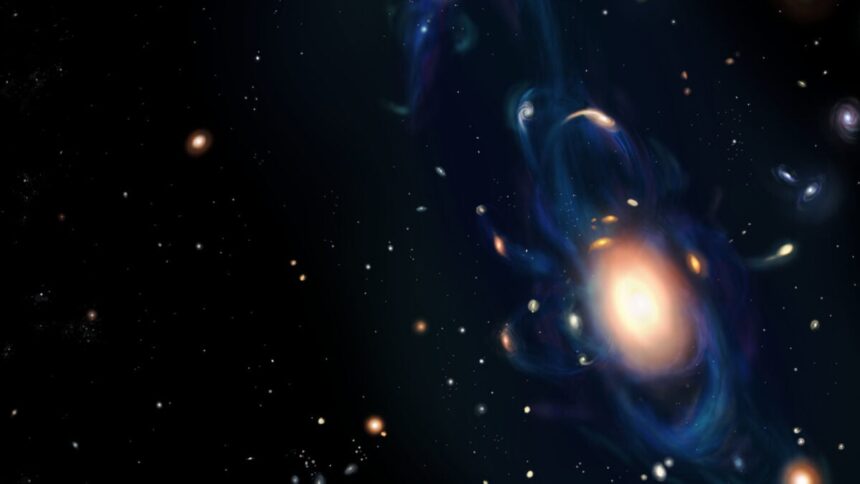
The team’s investigation also identified a stream of gas—roughly six times longer than the entire width of the Milky Way—flowing out of the host galaxy. This “tidal tail” was likely formed via the gravitational tug-of-wars between galaxies over hundreds of millions of years.
“The gamma-ray burst lies directly within one of these tidal streams, suggesting it took place inside a tiny dwarf galaxy formed from the material stripped away from its host during a galaxy collision,” Dichiara and study co-author Eleonora Troja, an astrophysicist at the University of Rome in Italy, wrote in a column on the findings for The Conversation.
Creation from destruction
The second question concerns how heavy elements pop up in stars located far away from the centers of galaxies. Heavier elements like iron emerge from chain fusion reactions within the most massive stars. When these large stars explode in a supernova and leave behind a core with a mass about three times smaller than the Sun, a neutron star is born.
These extremely dense stars are considered to be one of the universe’s key sources of even heavier elements like gold and uranium, according to the U.S. Department of Energy. Events like GRB230906A—an explosion of these densely packed elements—could essentially scatter the heavy elements in the outskirts of a galaxy, where a future star-to-be could grab the elements for itself, the researchers explained.
“We got a rare glimpse into how destruction can be a catalyst for creation,” Jane Charlton, the study’s senior author and an astrophysicist at Penn State, said in a university statement. “The heavy elements in our body, like iron for example, come from about 10,000 stars that were in our galaxy and died. It took billions of years, but that iron persisted on Earth, and as our bodies formed and evolved, they used that material.”
And the parallels could easily continue into our galaxy’s distant future, she added.
“Our own Milky Way galaxy has a neighbor, the Andromeda galaxy, and four or five billion years from now, it will merge with the Milky Way galaxy,” she mused. “This very thing could be happening, and tidal tails will form, kicking up heavy elements and enriching the universe.”
Read the full article here