

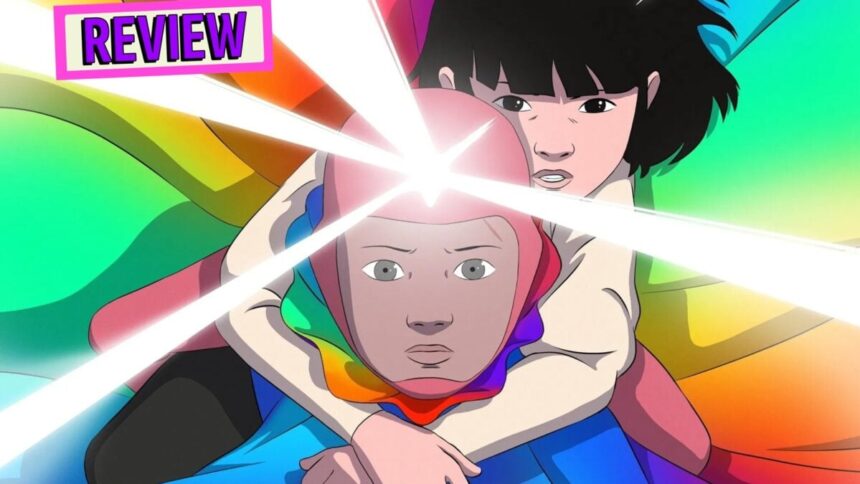
Stories set in the far future, be they animated or otherwise, have a knack for revealing something about what we think progress will cost us, whether that’s our environment, our relationships, or the fragile connective tissue tethering the two. Among them, Neon’s Oscar-nominated animated film Arco has the undeniable glow of an instant classic, with a warm, deeply felt story held up by visual awe that magically ties it all together.
Written by Féliz De Givry and Ugo Bienvenu and directed by Bienvenu, the film follows Arco (Juliano Krue Valdi), a 10-year-old boy from 3,000 years in the future who accidentally travels back in time to 2075. There, Arco discovers a world that’s long since given up on addressing environmental issues meaningfully and has instead decided to use technology to live years deep in the pocket of peril.
Arco develops a fast friendship with a girl named Iris (Romy Fay), and the pair ducks conspiratorial weirdos and a legion of automation assistants in a daring quest to jettison Arco back home on the tail of a rainbow.
As Neon’s second animated feature after Robot Dreams, Arco stands out most for its instantly timeless feel. Even as a brand-new animated tale, it carries the contemplative spirit and handcrafted warmth of certified classics like The Iron Giant, Tokyo Godfathers, and early-era Studio Ghibli films without feeling echoic of those giants.
Much of this comes from the film’s phantasmic animated sequences, intriguing worldbuilding, and tender character work, which give Arco a voice entirely its own. A voice that is strong from start to finish, worth hearing and seeing to believe, and in turn, feel moved by. At the center of that resonance is the bond between Iris and Arco, two children whose perspectives open windows into the film’s headier speculative fiction. Through them, Arco explores how young people make sense of a world shaped by forces far bigger than themselves—whether those forces are environmental or simply the emotional distance of adults around them flattened by technological advancements.
Here, the film contrasts Iris’ everyday reality, where humanity lives in a glorified terrarium alongside one another, with Arco’s future-flung wide-eyed wonder, using their differing outlooks on humanity in 2075 to highlight what each has lost and what each still hopes to find as they grow up in worlds at different stages of ruin. While the overarching message of Arco is an obvious one, interrogating a world as we watch whether the AI bubble will pop or evolve into a dome forever encasing humanity or if there can be a reversal of the doomsday clock with the environment, what the film has to say about it isn’t preachy or jerry-rigged into what’s ostensibly a time-traveling E.T. character where it trades a glowy-digited alien for a child in a rainbow cloak. Still, the emotional storm Arco weaves for the two to weather along their journey is incredibly tender, absorbingly strange, and quietly hopeful.
What’s most striking about the movie is how Arco gestures toward the anxieties of the moment without ever becoming didactic, while crafting a moving sci-fi tale that avoids tipping into the bleakness it spells out for our present. Instead, Bienvenu and Girvy guide the film with a measured hand, creating an imaginative journey between Iris and Arco that’s steeped in melancholy, sure, but also optimistic.
What’s more, the film’s fleeting sense of hope-making doesn’t claim to have the answers that’ll save Iris and Arco’s world or ours by proxy but trusts deeply in the resilience required to keep searching for a better world. Crucially, the film resists the temptation to have its young protagonists spell out its themes in neat, tidy speeches. Instead, those ideas surface organically through their playful and inquisitive interactions, deafening silences, and the visual contrast between their worlds. In the mix is an animated film with a thoughtful balance of tone and texture for all ages—a film that’s charming and visually transportive without losing sight of the emotional undercurrents that give it weight.
Arco‘s star-studded voice cast—Natalie Portman, Mark Ruffalo, Will Ferrell, America Ferrera, Andy Samberg, and even Flea—never bigfoots the kids at the center of the film. If anything, their performances feel intentionally dialed back in an almost “showed up to work” kind of way that ends up aiding the film rather than harming it. Their collective restraint and by-the-numbers performances give Iris and Arco the space to shine. In a meta sense, their roles are the epitome of support, where the adults become the frame, not the painting, and the kids’ scenes hit harder because of it.
That’s not to say Arco is without its blemishes. Its brisk, “here for a good time, not a long time” pacing means the journey occasionally feels bottlenecked, leaving you wishing the film lingered a little longer—if not to soak in more of its gorgeous world, then simply to sit with its characters and let their emotional arcs breathe. And then there’s the thornier point: the film’s use of AI-generated synthetic voices for its robots, most notably Mikki, whose sound blends the timbres of Portman and Ruffalo (who play Iris’ parents) into something that can only be intentionally uncanny.
For some viewers, that choice may jolt the vibe. But within the film’s thematic framework—where artificial connection stands in for the real thing—it’s one of the few instances in contemporary animation where AI feels pointed rather than gimmicky. Even so, a couple of abrupt character turns and the sense that the story wraps just as you’re fully settling into its rhythms are reminders that Arco‘s ambition occasionally outpaces its runtime.
Aside from the TransPerfect Speech AI jump scare revelation in its credits, what lingers after Arco’s finale is that it manages to stick the landing where it counts. It feels like a dispatch from a future that still believes in humanity’s fight to make that future better. What you’re left with is a quietly gorgeous film that leaves you feeling something real, warm, and human, which is no small feat for a movie about a world forgetting what that means.
Arco is now playing in theaters.
Want more io9 news? Check out when to expect the latest Marvel, Star Wars, and Star Trek releases, what’s next for the DC Universe on film and TV, and everything you need to know about the future of Doctor Who.
Read the full article here