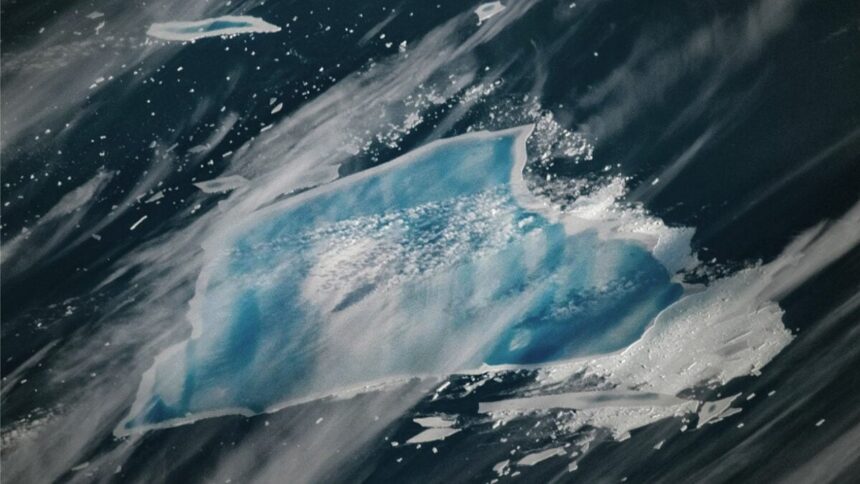
New satellite images of what was once the largest iceberg in the world show warning signs of its imminent demise, revealing extensive pools of aquamarine blue water melting on its surface.
NASA’s Earth-observing Terra satellite captured an image of what remains of iceberg A-23A in Antarctica, which suggests it may have sprung a leak and is only days away from completely disintegrating.
The iceberg is breaking apart while drifting in the South Atlantic between the eastern tip of South America and South Georgia Island.
Drift apart
Iceberg A-23A has had a long and arduous journey. It first broke off from Antarctica’s Filchner Ice Shelf in 1986. Afterwards, the iceberg remained lodged on the seafloor of the southern Weddell Sea for decades before breaking free in the early 2020s and drifting northward.
In March 2024, it was caught in a rotating ocean vortex in the Drake Passage before spinning out and becoming lodged again on the shallow coastal shelf south of South Georgia Island. The iceberg freed itself once more before coming to its final rest stop north of the island.
When it was first detached, the iceberg was around the size of Rhode Island, measuring roughly 1,500 square miles (4,000 square kilometers). Today, the iceberg is around 456 square miles in size (1,182 square kilometers), still larger than New York City.
Scientists have been tracking the iceberg’s journey for years using satellite imagery, allowing them to document its disintegration over time. Today, scientists estimate that the iceberg won’t be around for much longer, giving it days to weeks before its complete disintegration.
“I certainly don’t expect A-23A to last through the austral summer,” Chris Shuman, a retired scientist at the University of Maryland Baltimore County, said in a NASA statement. “A-23A faces the same fate as other Antarctic bergs, but its path has been remarkably long and eventful.”
Watching from above
Using the Moderate Resolution Imaging Spectroradiometer (MODIS) on the Terra satellite, scientists observed the remains of the waterlogged iceberg. The image shows pools of meltwater on its surface, turning the iceberg a haunting blue color.
An astronaut on board the International Space Station (ISS) has also captured a closer image of the iceberg, revealing streaks of blue and white that likely accumulated when the ice was part of a glacier dragging across Antarctic bedrock. “The striations formed parallel to the direction of flow, which ultimately created subtle ridges and valleys on the top of the iceberg that now direct the flow of meltwater,” Walt Meier, a senior research scientist at the National Snow & Ice Data Center, said in the statement.
“It’s impressive that these striations still show up after so much time has passed, massive amounts of snow have fallen, and a great deal of melting has occurred from below,” Shuman said.
The MODIS image also reveals that the iceberg may have sprung a leak. The weight of the water pooling at the top of the iceberg would have created enough pressure at the edges to push through, resulting in a white area on the left side of the image.
A-23A is currently on thin ice, floating in water that’s around 37 degrees Fahrenheit (3 degrees Celsius) and heading toward even warmer temperatures. “It’s hard to believe it won’t be with us much longer,” Shuman said.
Read the full article here