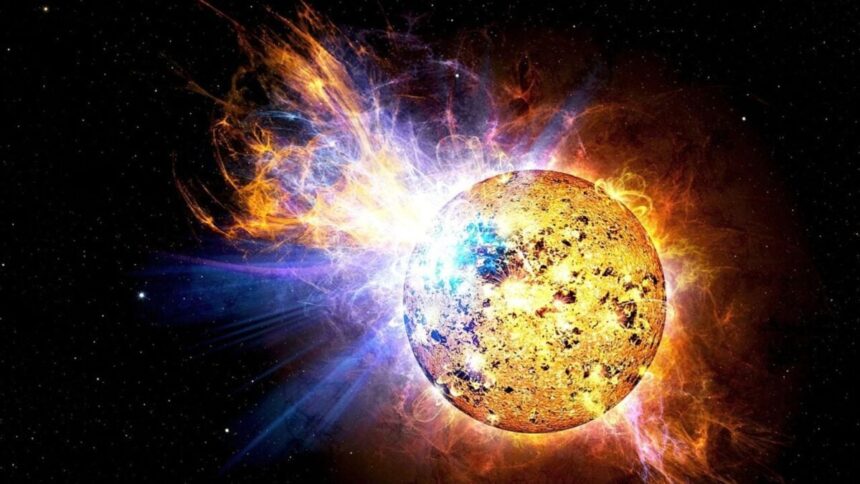
The star that gives Earth life is also incredibly violent. The Sun frequently erupts with solar storms that can make technology go haywire when directed at our planet. But compared to other stars of its size, temperature, and variability, ours is strangely quiet.
Research has shown that stars like our Sun produce “superflares,” extreme solar flares more powerful than trillions of hydrogen bombs, about once per century. Based on this and other lines of evidence, it stands to reason that the Sun should too, and yet scientists have never observed one. They have found traces of intense onslaughts of high-energy solar particles that have occurred throughout Earth’s history, such as spikes in concentrations of radioactive isotopes inside tree trunks, ice cores, and even meteorites. Still, it’s not clear that these particle eruptions stemmed from superflares.
Whether the Sun is capable of these enormous explosions is a question of critical importance. An Earth-directed superflare could collapse entire power grids, destroy satellites, trigger global radio blackouts, and lead to cascading infrastructure failures that result in trillions of dollars in damages.
In a new study published in the journal Philosophical Transactions of the Royal Society A, scientists took a different approach to answering this question. They found new evidence to suggest our home star could someday unleash a superflare.
Superflare potential
The researchers, led by Natalie Krivova of the Max Planck Institute for Solar System Research, analyzed data from NASA’s Solar Dynamics Observatory to estimate the maximum strength of a solar flare.
They sifted through observations gathered from 2010 to 2016 and identified the 300 strongest flares that occurred during that period. Then, the team correlated the amount of energy each flare released with the size of the active region it came from. Active regions are areas on the Sun’s surface associated with sunspots, where the magnetic field is particularly strong and structurally complex. When it becomes tangled, it snaps like a rubber band, releasing a burst of energy known as a solar flare.
“Of course, we knew that no superflares had occurred during the observation period,” Krivova explained in a statement. “But the statistical relationship we found between the released energy and the size of the active region should hold true for more powerful events as well,” she said.
With this relationship established, Krivova and her colleagues then analyzed the largest sunspots ever recorded on the Sun’s surface. Based on their size, the researchers inferred the size of their associated active regions, then inferred the maximum strength of a solar flare that could have erupted from these areas.
The analysis revealed that the largest historical sunspot groups were theoretically capable of producing superflares, though the researchers emphasize that their study did not address the probability or expected frequency of such events.
“Our Sun has superflare potential,” Krivova said. “It can produce massive sunspots that, in principle, can serve as the starting point for the most extreme bursts of radiation.”
The need to prepare
If the Sun is capable of producing superflares, the obvious next question is, why haven’t we seen one?
Well, humanity has only been studying the Sun for a tiny fraction of its lifespan. While previous research suggests that Sun-like stars produce a superflare about once every 100 years, that’s a statistical average across thousands of stars, not a fixed schedule. The Sun may have produced superflares before, but so long ago that any evidence has either disappeared or can’t be definitively linked to a superflare.
Powerful solar flares have occurred throughout recorded history, however. The largest ever documented with modern instruments erupted from late October to early November 2003. While these flares were extremely energetic, they fell short of superflare status.
Still, the resulting solar storms affected over half of all Earth-orbiting spacecrafts, forced several deep-space missions to enter safe mode or shutdown, and forced astronauts aboard the International Space Station to take shelter from radiation. On Earth, the storms disrupted radio communications and GPS systems.
Such events—and the physical plausibility of superflares—underscore the need to harden infrastructure against the threat of extreme solar storms. In our technology-dependent era, understanding our Sun’s volatility has never been more important.
Read the full article here