The Amazon rainforest, often called the lungs of our planet, is buckling under the pressure of rampant deforestation and climate change. Now, another threat is emerging, and scientists worry it could push this essential ecosystem over the edge.
It’s looking increasingly likely that this El Niño, which arrived in June, will become the strongest on record. The latest forecasts show sea surface temperatures in the equatorial Pacific Ocean peaking around 7.2 degrees Fahrenheit (4 degrees Celsius) in December, obliterating the previous record and supercharging global temperatures. El Niño alters weather patterns around the world, and in the Amazon, it typically worsens drought and wildfires. The stronger the El Niño, the more likely it is that these expected outcomes will occur.
In a Nature news feature, several researchers express concern that this event could push the rainforest past its “tipping point,” a critical threshold at which runaway drought, wildfire, and tree death cause the ecosystem to collapse and transition to a degraded savanna. This would be devastating not only for regional communities, biodiversity, and weather patterns, but also for the global climate, as the Amazon stores an amount of carbon equivalent to 15 to 20 years of global CO2 emissions.
An ecosystem at the brink
The Amazon’s tipping point has long been a subject of scientific debate. While scientists generally agree that human-driven pressures could push the rainforest to collapse, questions remain about the timing, circumstances, and extent of its collapse.
A study published in May suggests the Amazon may be closer to a tipping point than previously thought. The researchers found that if Earth’s average temperature rises just 2.7 to 3.42 degrees Fahrenheit (1.5 to 1.9 degrees Celsius) above pre-industrial levels and 22% to 28% of the rainforest is deforested, as much as 77% of this ecosystem could undergo major changes.
Scientists have estimated that roughly 17% of the forest has already been destroyed by human disturbances such as logging, edge effects, and understory fires, though extreme droughts over the past few decades could have increased that figure to 38%. Meanwhile, global surface air temperature has risen about 2.5 degrees F (1.4 degrees C) since the pre-industrial era.
“We’re not too far away,” Nico Wunderling, an Earth-system modeler at Goethe University in Frankfurt, Germany, who led the study published in May, told Nature News.
As El Niño forecasts grow increasingly dire, some researchers believe it could be the straw that breaks the camel’s back, but that will depend on how strong it actually becomes.
The growing toll of super El Niños
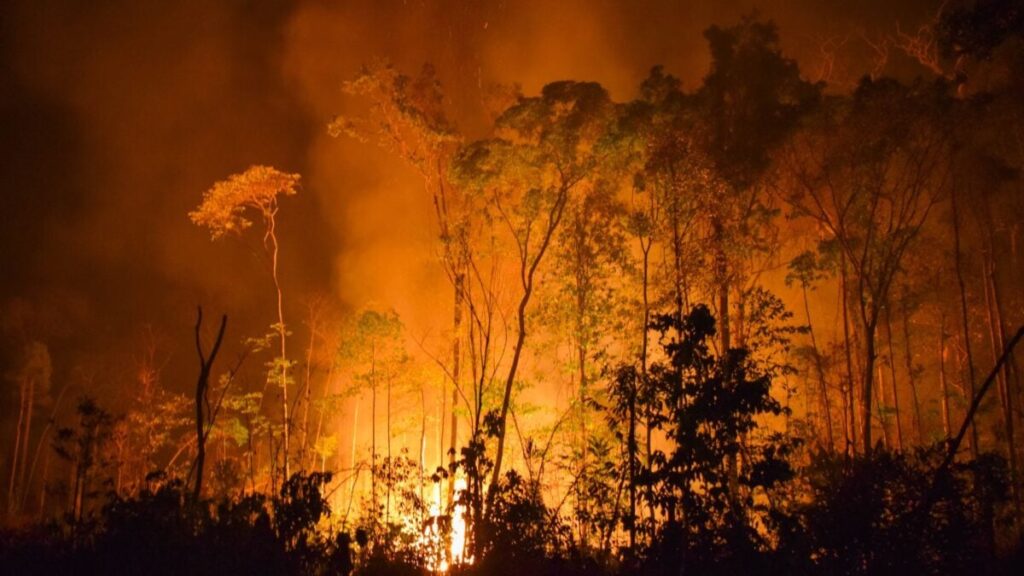
Previous strong El Niños have tested the Amazon’s limits, causing lasting damage on top of the destruction wrought by deforestation and climate change. El Niño-related droughts fueled rampant wildfires that devoured more than 44.2 million acres of rainforest in 2024, an area larger than the state of California.
Large portions of the Amazon may still be recovering from this event, according to a study published in March. The researchers predicted that less than 50% of the affected areas will recover within seven years of the 2023-2024 droughts.
“Our results therefore highlight the growing vulnerability of the Amazonian rainforests to intensifying climate extremes driven by El Niño events and ongoing anthropogenic climate change, providing evidence that these forests are approaching the limits of their preindustrial operating space,” the study states.
Bernardo Flores, a specialist in Amazon resilience at the Juruá Institute in Manaus, Brazil, told Nature News that once a patch of the rainforest burns, it remains flammable for decades.
“And then if we continue to have these escalating El Niños—these El Niños that get stronger and stronger—then it’s very concerning,” he said. “The area of flammable forest just increases and increases, and it can become exponential.”
The Amazon has survived 65 million years of climate variability, but the combined impact of deforestation, global warming, and a potentially unprecedented El Niño could irreversibly alter this rainforest—and exacerbate climate change in the process. Taking steps to reduce carbon emissions, forest-degrading activities, and prevent wildfires in this region has never been more important.
Read the full article here