
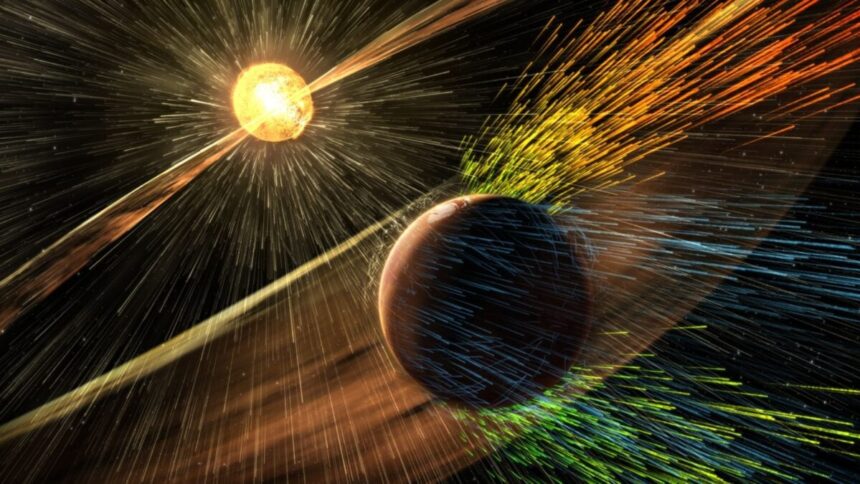
When the surface of the Sun exploded with activity in May 2024, Earth was hit by the biggest solar storm in more than two decades. The video shown below—made from images captured by NASA’s Solar Dynamics Observatory—shows the powerful solar flare and coronal mass ejection that sent an onslaught of charged particles hurtling toward us. But of course, our planet wasn’t the only one in the line of fire.
A study published today in the journal Nature Communications investigated how this surge of radiation and solar material impacted Mars. The researchers analyzed data gathered by two European Space Agency orbiters, Mars Express and the ExoMars Trace Gas Orbiter (TGO), which have been studying the Red Planet’s atmosphere for years. They determined that the solar storm caused the lower layer of Mars’s ionosphere to expand dramatically, growing to nearly three times its typical size.
“The impact was remarkable,” lead author Jacob Parrott, an ESA research fellow, said in an agency statement. “Mars’s upper atmosphere was flooded by electrons. It was the biggest response to a solar storm we’ve ever seen at Mars.”
Storm of the century
The solar superstorm emanated from an active sunspot region called AR3664. Clusters of sunspots like this one are notorious for producing explosive solar phenomena, such as solar flares (sudden bursts of photons) and coronal mass ejections (eruptions of plasma from the Sun’s corona).
In May 2024, AR3664 produced several large flares and a series of CMEs while facing Earth. This sent large amounts of fast-moving magnetized plasma rocketing toward our planet. When this charged material interacted with Earth’s magnetosphere, it triggered an enormous geomagnetic storm, possibly the largest recorded this century, according to NOAA.
While the effects of solar weather on Earth are relatively well understood, its impact on other planets is not. Fortunately, ESA’s Mars orbiters were in the right place at the right time when this storm hit, offering a rare opportunity for researchers to study how massive influxes of solar plasma and radiation interact with the Red Planet.
That opportunity was nearly lost when the storm caused Mars Express and TGO to glitch. “The storm also caused computer errors for both orbiters—a typical peril of space weather, as the particles involved are so energetic and hard to predict,” Parrott explained. “Luckily, the spacecraft were designed with this in mind, and built with radiation-resistant components and specific systems for detecting and fixing these errors. They recovered fast.”
Solar dynamics shape Mars
To investigate the storm’s impact, Parrott and his colleagues used a technique called radio occultation. This required ESA’s two Mars orbiters to work together. Mars Express beamed a radio signal to TGO as it disappeared over the Red Planet’s horizon, which caused the signal to be bent by the layers of the atmosphere before TGO received it. This allowed the researchers to gather information about each distinct layer.
First, Mars Express beamed a radio signal to TGO at the very moment it was disappearing over the Martian horizon. Parrott and his colleagues were able to track how the signal changed as it passed through the various layers of Mars’s atmosphere, then convert those changes into a measurement of how many charged particles were in the planet’s ionosphere.
This revealed dramatic swelling of the lower ionosphere caused by the barrage of solar plasma and X-rays. The researchers believe this material collided with neutral atoms in Mars’s upper atmosphere and stripped away their electrons, boosting the number of free electrons and charged particles. They note, however, that without direct measurements of how the solar flare’s energy spectrum changed, it’s difficult to know exactly how many extra electrons were created.
The researchers said their findings have improved scientists’ understanding of Mars by revealing how solar storms inject energy and particles into its atmosphere. This is important because experts know the planet has lost huge amounts of water and most of its atmosphere to space, and one of the most likely drivers is the constant onslaught of solar wind. Continuous, high-resolution monitoring of the Martian ionosphere, particularly during periods of heightened solar activity, will significantly strengthen our understanding of the Red Planet’s atmosphere, the authors state.
Read the full article here