
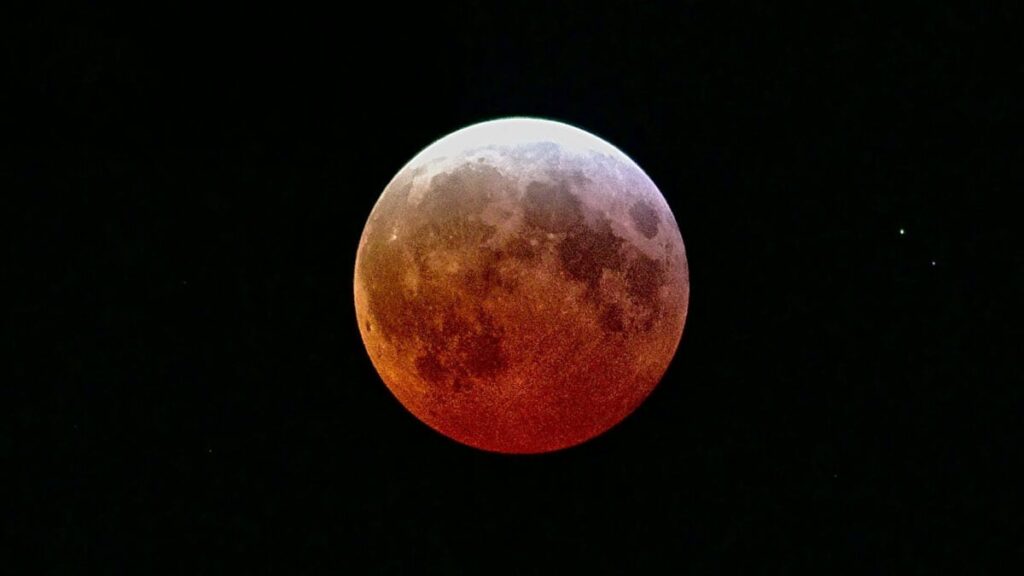
If you missed the eerie darkness of the total solar eclipse earlier this month, fret not—eclipse season isn’t over yet. Eclipses often arrive in pairs, and now it’s the Moon’s turn to put on a show as a nearly total lunar eclipse prepares to dramatically dim the night sky.
A deep partial lunar eclipse will occur on August 27-28, when the Moon slowly dips behind Earth’s shadow and takes on a striking red or copper color. The eclipse will be visible across North and South America, Africa, Greenland, Iceland, and western Europe.
This is your last chance to see a major lunar eclipse event before the next one takes place on New Year’s Eve of 2028, so we recommend that you read along for a full guide on how to enjoy the Moon’s spectacle.
When to see the lunar eclipse
Unlike solar eclipses, lunar eclipses progress much more slowly. It takes the Moon several hours to slide behind Earth’s shadow, giving you plenty of time to gaze at its beauty.
Thursday’s lunar eclipse begins at 9:23 p.m. ET when Earth’s faint outer shadow begins crossing the Moon’s face. It starts off subtle before things start to pick up at 10:33 p.m. ET. That’s when the partial eclipse begins as Earth’s dark umbra, the central part of the planet’s shadow, begins to make its way across our view of the Moon. Earth will begin to cast a dark shadow on one edge of the Moon.
The maximum eclipse will take place at 12:13 a.m. ET on Friday. At its peak, 96% of the Moon will lie within Earth’s dark umbral shadow. During that time, the Moon will appear dimmed and change color to a copper-like hue across most of its visible surface. A small sliver of the Moon will remain outside of Earth’s shadow, appearing bright in contrast with the rest of the natural satellite.
The Moon will then begin to move out of Earth’s shadow, and our planet’s deep cast will slowly start to creep away. As this happens, the different phases will play out in reverse. The partial eclipse ends at 1:51 a.m. ET, and the penumbral eclipse concludes at 3:01 a.m. ET.
From start to finish, the eclipse will last for 339 minutes, or just a little shy of six hours.
The Moon’s color changes during an eclipse as sunlight passes through Earth’s atmosphere. Without Earth’s shadow, the Moon reflects bright sunlight. Earth’s atmosphere, however, filters and bends sunlight. Colors with shorter wavelengths, like blue, scatter as they hit gas particles while colors with longer wavelengths, like red and orange, pass through.
How to view the lunar eclipse
Lunar eclipses take place Earth-wide, but you need to be in a place where it is nighttime in order to see it. Sky watchers in North and South America will be treated to ideal viewing conditions, while the eclipse takes place during the early morning hours on Friday for those in Europe.

If you’re not in an area where the upcoming lunar eclipse will be visible, you can also tune in to the astronomical event live through one of the live feeds below.
You don’t need special equipment to view a lunar eclipse. Unlike a solar eclipse, it’s totally safe to look up at the Moon as it dips into Earth’s shadow. And since it takes place over several hours, there’s a large window during which you can marvel at the celestial wonder.
Read the full article here