Capybaras have fast become one of the internet’s favorite animals. Turns out, they might also be helping scientists learn more about the ancient past.
Researchers at the University of Arizona and others have just announced the discovery of a fossilized capybara tooth in Chile dating back nearly nine million years ago, and the fossil may reshape our current understanding of the area where it was located, the Atacama Desert. It’s presence suggests that at least parts of this desert, considered one of the oldest on Earth, haven’t always been so arid.
“The presence of Cardiatherium in the Atacama Region implies the existence of substantially wetter conditions along the Pacific coast during the late Miocene than occur today,” they wrote in their paper, published this month in the journal Scientific Reports.
A capybara upheaval
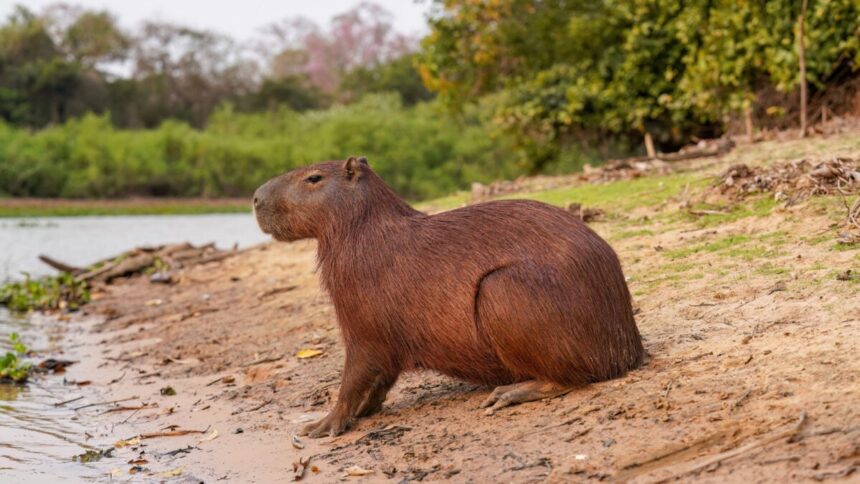
Capybaras are the largest living rodents, with only two species still around today. These plant-eating animals are found in just about every country in South America, with the notable exception of Chile. This fact alone would make the team’s discovery noteworthy, but it’s where they unearthed the fossil that makes it even more extraordinary.
The tooth belongs to a member of the now-extinct genus of Cardiatherium, which were likely direct ancestors of today’s capybaras. Dated to roughly 8.8 million years ago, it was found in sediment layers that had been deposited in a shallow marine environment at the Bahía Inglesa Formation, a fossil-rich area located in the Atacama Desert.
The Atacama Desert is found along the coast of northern Chile. It’s one of the driest areas in the world and is thought to have continuously existed in this hyper-arid state for at least 40 million years or so, which would make it the oldest non-polar desert on Earth. Capybaras, meanwhile, are semiaquatic and need plenty of water and wetland vegetation to thrive—pretty much the opposite of what the Atacama region provides these days.
“Finding a capybara tooth in a marine deposit in what today is one of the driest regions on Earth is just freakish,” said lead author Priscilla Martinez, a doctoral student at the University of Arizona’s Department of Geosciences, in a statement provided by the university.
The capybara tooth alone might not be enough to overturn the perception that Atacama was always entirely a desert. But the researchers also found evidence of palms and other flowering plants that likely existed right around the time that this capybara would have lived. Put it all together, and the researchers argue that parts of southern Atacama were once lush with freshwater ecosystems that would have made an ideal long-term home for ancient capybaras.
More to learn
The researchers say there are still many unanswered questions about this discovery and its implications. The exact layout of the ecosystems that would have connected Chile to the rest of South America where these capybaras lived is still unclear, though the researchers present two different hypothetical routes in their paper. And we don’t know entirely why the Atacama region lost these environments over time.
Finding an answer to these and other questions could provide important lessons today, the researchers say.
“The more we understand deserts, which are extremely sensitive to changes in climate, including shifts in monsoon intensity from year to year, the better we can predict how they fare long term,” Martinez said. “And if we can understand past climate changes that had nothing to do with humans, it gives us a baseline to work off of to understand how climate can evolve over time with humans in the mix.”
Capybaras are known to be some of the chillest animals in the world. Now they’re also history teachers.
Read the full article here