

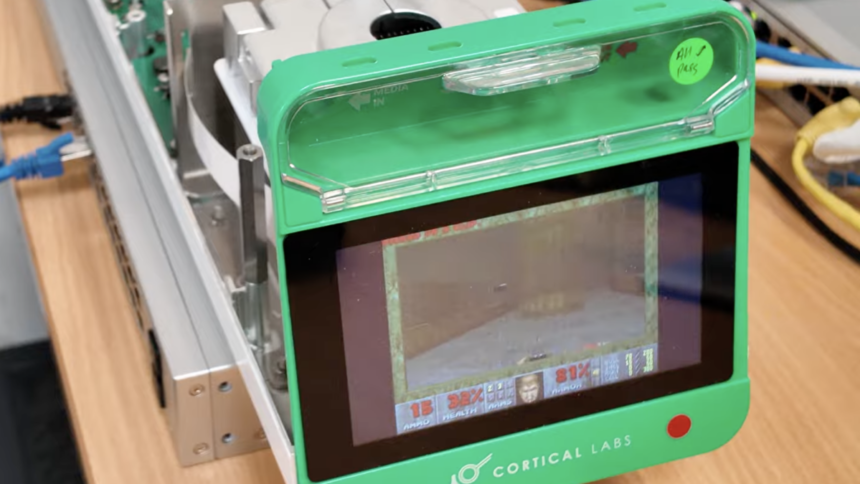
A couple of years ago, a company called Cortical Labs released a video that showed a simplified version of Pong being played by a culture of human neurons in a Petri dish. The idea that a bunch of neurons in a dish can do anything is impressive enough, but it turns out that things have gotten significantly crazier since then, because the company has now managed to get a similar culture of neurons to play Doom.
In a very slick marketing video, the company demonstrates “real neuron gameplay”: Doom running on its CL-1 neural computing system, a microchip upon which 200,000 human neurons are mounted in something called a “multi-electrode array.” (For comparison, while the exact number of neurons in an average human brain remains the subject of some debate, it’s in the order of tens of billions—which really just reinforces how astonishingly powerful and complex our own brains are.)
Anyway, this video is wild—and it just gets wilder as various company representatives explain exactly what’s going on.
First, the chip isn’t running Doom; it’s playing Doom. Or, to be more accurate, various elements of the on-screen data are being mapped to patterns of electric stimuli, which are then transmitted to the neurons. The neurons respond to these stimuli with signals of their own, which control the on-screen character’s actions: “If the neurons fire in a specific pattern, Doomguy shoots. If they fire in another pattern, he moves to the right. And so on.”
At one point, a researcher shows some microscope images of the chip, and we see how intricate and very clearly organic webs of neurons wind around the crisp, straight lines of circuitry. It looks like something straight out of a sci-fi film. I mean, look at this:
The other thing is that the neurons are learning. At present, they’re not particularly good at Doom: “The cells play like a beginner who’s never seen a computer. And in all fairness, they haven’t.” But give them a couple of years, and who knows? The plasticity of the networks that neurons form is a big part of what makes our own brains so powerful and adaptable. If these networks adapt in the same manner, we might just find that they end up being very, very good at Doom.
(With that said, save for a couple of short exceptions, the footage doesn’t actually depict Doom. The neurons are playing Freedoom, which runs on the Doom engine—which has been open-sourced for decades—but uses none of Doom’s iconic demons or weapons, which remain under copyright. We have nothing against Freedoom per se, but come on—can we not at least furnish our future brain-in-a-vat overlords with a proper copy DOOM.WAD?)
There are obviously many fascinating and potentially troubling questions raised by this sort of technology. One that springs to mind immediately is, “Whose cells are these?” They must contain somebody’s DNA. Are we going to end up with another Henrietta Lacks situation two decades down the line, where every one of the neurocomputers thrashing everyone online at Call of Duty 17 contains neurons that originate with the same person?
The company has launched something it’s calling the “Cortical Cloud,” which promises to allow developers the world over to experiment with the CL-1 via a Python-based API. This collegiate spirit is admirable, but the idea of human neurons ending up being used to generate AI porn or something feels… unpleasant. Who knows, though? Maybe in a couple of generations’ time, it’ll feel just as commonplace as today’s insanely complicated processors being used for the same purpose.
Read the full article here