
By using this site, you agree to the Privacy Policy and Terms of Use.
Accept
Tech Consumer JournalTech Consumer JournalTech Consumer Journal
  • News
  • Phones
  • Tablets
  • Wearable
  • Home Tech
  • Streaming
  • More Articles
Reading: 122 Companies Are Quietly Sucking the West Dry, Study Finds
Share
Sign In
Notification Show More
Font ResizerAa
Tech Consumer JournalTech Consumer Journal
Font ResizerAa
  • News
  • Phones
  • Tablets
  • Wearable
  • Home Tech
  • Streaming
  • More Articles
Search
  • News
  • Phones
  • Tablets
  • Wearable
  • Home Tech
  • Streaming
  • More Articles
Have an existing account? Sign In
Follow US
  • Contact
  • Blog
  • Complaint
  • Advertise
© 2022 Foxiz News Network. Ruby Design Company. All Rights Reserved.
Tech Consumer Journal > News > 122 Companies Are Quietly Sucking the West Dry, Study Finds
News

122 Companies Are Quietly Sucking the West Dry, Study Finds

News Room
Last updated: August 25, 2026 4:20 pm
News Room
Share
SHARE

After more than a quarter-century of drought in the Colorado River Basin, water levels in America’s largest reservoirs recently plummeted to historic lows. As this crisis reaches a boiling point, new research shows that just 122 companies are responsible for about half of the West’s climate change-driven water losses over the past decade.

Between 2014 and 2024, global warming reduced the American West’s snowpack by more than a third, choked the region’s warm-season streamflow by roughly 13%, and increased irrigation demand by 4.3%, according to a study published today in Nature’s Communications Earth & Environment journal. The authors traced about half (40% to 64%) of these impacts to emissions from 122 “carbon majors” since 1950.

“Due to their outsize contributions of carbon to the atmosphere and their decades-long deception concerning climate change, fossil fuel companies should face accountability for their climate harms,” several of the authors associated with the Union of Concerned Scientists wrote in a statement.

Dwindling supply

The carbon majors are the world’s largest producers of fossil fuels and cement, including publicly traded and state-owned companies. Collectively, they are responsible for the vast majority of historical industrial greenhouse gas emissions. In their statement, the authors from the Union of Concerned Scientists list BP, Chevron, ExxonMobil, and Shell as examples.

In this first-of-its-kind study, the researchers used observational data and climate modeling to quantify how emissions from 122 carbon majors since 1950 have contributed to water cycle disruptions across the western United States. They found that the impact these companies have had on the West’s April snowpack alone has drained more than 9 trillion gallons of water from the region over the past decade. That’s roughly equivalent to the maximum capacity of Lake Mead, the largest reservoir in the United States.

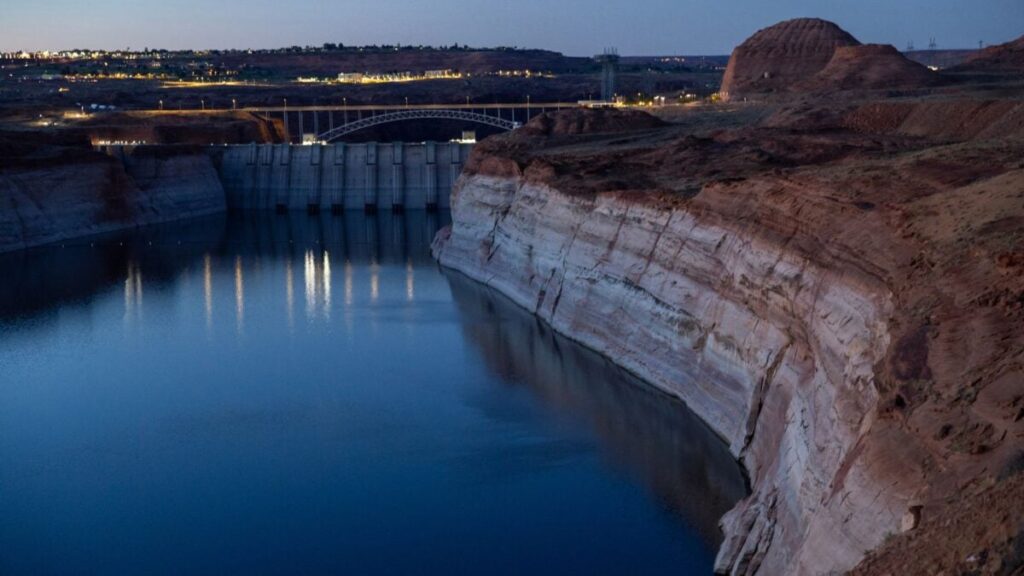
Both Lake Mead and Lake Powell, the nation’s second-largest reservoir, are currently at their lowest points since they were filled in the 1900s. These unprecedented conditions stem largely from a historic snow drought that deprived the Colorado River Basin of meltwater this past spring. More than 70% of the river’s natural flow depends on snowmelt, but in March, Colorado’s snowpack sat at just 40% of normal levels.

The researchers also found that emissions from carbon majors have reduced warm-season streamflow by nearly 4 trillion gallons annually, which is roughly equivalent to the combined volume of California’s four largest reservoirs. Interestingly, they also attributed an increase in annual October-to-March streamflow to the carbon majors, but this only offsets about half of the annual warm-season reduction.

Rising demand

Climate change reduces water availability in the West by altering precipitation patterns, but it also increases demand. Rising temperatures are creating a thirstier atmosphere that draws more water out of soils, forcing the region’s multibillion-dollar agricultural industry to pull more water for irrigation.

In the past decade, carbon-major emissions have driven a 2.4% increase in irrigation demand across the West, according to the study. The researchers identified “hot spots” in the Pacific Northwest and California where large reductions in water supply coincide with large increases in irrigation demand, including agriculturally critical basins such as the Middle Columbia, San Joaquin, and Sacramento.

Water demand has consistently outpaced supply in the Colorado River Basin since the early 2000s, resulting in a decades-long drought.

On Friday, the Trump administration released a two-year operating plan that would require Arizona, California, and Nevada to cut their Colorado River water use by a combined 400 billion gallons per year. Nevada has since filed a federal lawsuit asking the District Court to order the Bureau of Reclamation to rescind the plan.

This marks the first major legal battle over the West’s water crisis. But as evidenced by this new study, the carbon majors have played a key role in the scarcity now driving this fight. Whether we hold them responsible will be critical for the future of this region and the global climate.

Read the full article here

You Might Also Like

This Was a Bad Day for People Who Hate X but Sometimes Like to Read X Posts Anyway

At Trial, Instagram Head Denies Having ‘Stalled’ Teen ‘Take a Break’ Feature Despite Slow Rollout

Uber Is Letting Parents Keep an Eye on Their Teens Through a Driver’s Phone Camera

War for Westeros’ Gameplay Trailer Captures the Excitement of the Series

Congresswoman Wants to Add Images to Legislation to Keep Pace With the Post-Literate Future

Share This Article
Facebook Twitter Copy Link Print
Previous Article Evidence of Ancient Sharks Found Buried in the Egyptian Desert
Next Article Bitcoin Tops $80,000 as the Treasury Secretary Weakens the Dollar
Leave a comment

Leave a Reply Cancel reply

Your email address will not be published. Required fields are marked *

Stay Connected

248.1kLike
69.1kFollow
134kPin
54.3kFollow

Latest News

Keep Building, but Keep It Hush-Hush
News
‘Backrooms’ Maps a Path to HBO Max in September
News
Scientists Studied 338 NFL Players’ Brains After Death. Nearly All Had the Same Disease
News
Legal Experts Are Alarmed the SEC Isn’t Investigating Trump-Linked Crypto Venture
News
Perplexity Launches Local AI Model That Will Run on Your GPU Instead of the Cloud
News
Bitcoin Tops $80,000 as the Treasury Secretary Weakens the Dollar
News
Evidence of Ancient Sharks Found Buried in the Egyptian Desert
News
New Plain Old AirPods 5 (Without Cameras) Could Arrive Next Month
News

You Might also Like

News

Apple’s M5 Ultra Mac Studio Goes For Absolutely Bonkers Performance

News Room News Room 5 Min Read
News

Astronomers Think They’ve Found the Best Evidence for Dark Matter Yet

News Room News Room 4 Min Read
News

‘Obsession’ Is the Highest-Grossing Original Film of the Decade

News Room News Room 4 Min Read
Tech Consumer JournalTech Consumer Journal
Follow US
2024 © Prices.com LLC. All Rights Reserved.
  • Privacy Policy
  • Terms of use
  • For Advertisers
  • Contact
Welcome Back!

Sign in to your account

Username or Email Address
Password

Lost your password?